
DOK Leipzig standout: Vincent Graf in conversation about “Nonna”
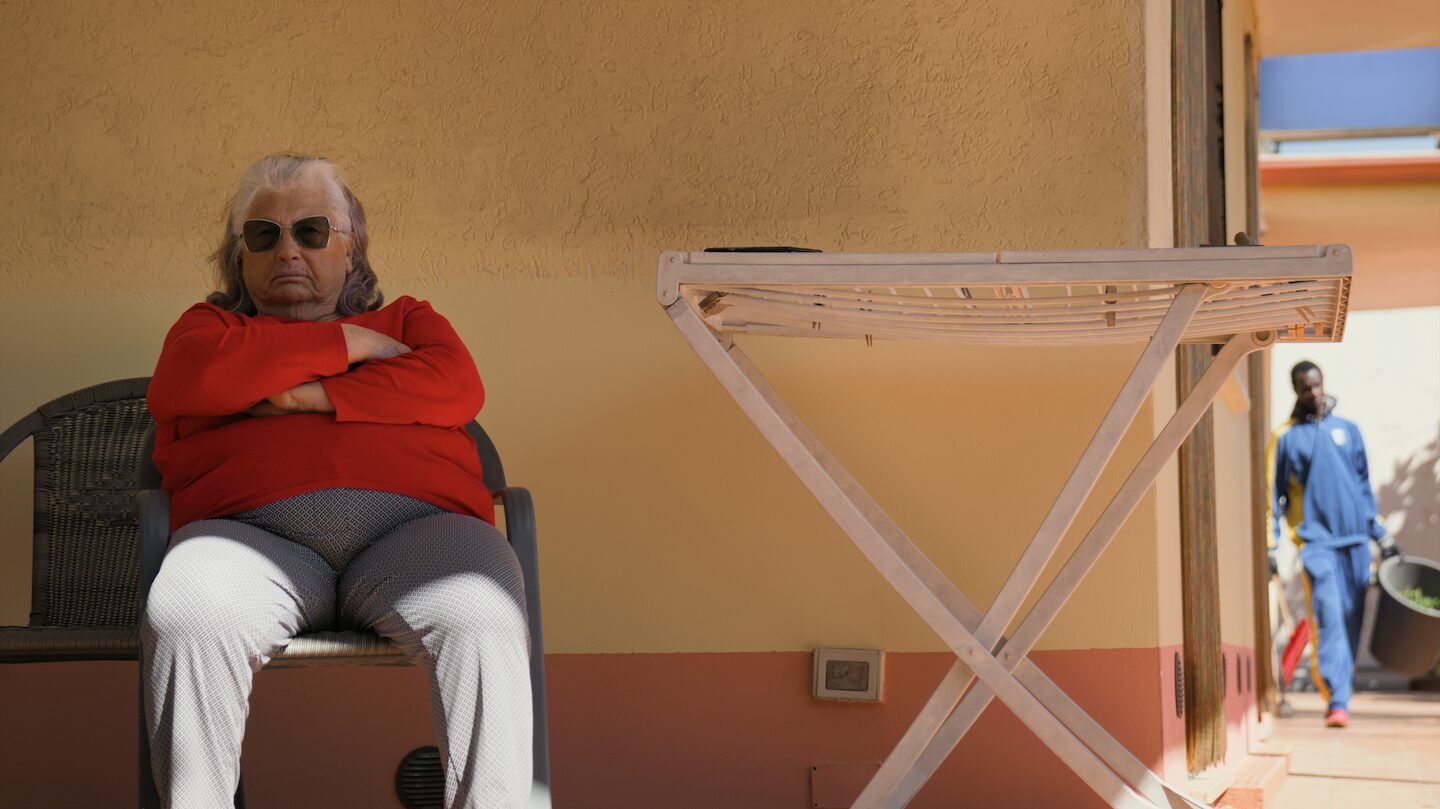
Attending DOK Leipzig for the first time this year felt like stepping into a vibrant constellation of urgent stories, bold artistic voices, and unexpected emotional turns. During the three last days of the festival, I encountered very diverse films that were each a revelation. My festival journey began with Vincent Graf’s “Nonna,” shown in a packed arthouse cinema in the heart of Leipzig, and I truly couldn’t have imagined a warmer introduction to DOK Leipzig. The film is an affectionate, spirited portrait of the filmmaker’s larger-than-life grandmother, whose vibrant, sharp-witted presence illuminates every frame.
Living alone in her small B&B in southern Italy, Nonna’s days oscillate between long stretches of solitude, lively video calls with her family in Germany, and hilariously circular arguments with her brother. Yet, despite the quietness of her daily routine, she radiates a vitality that feels both touching and invigorating. Graf captures her with tenderness and humour, reminding us that old age can be lived on one’s own terms — whether with a mischievous smile, a razor-sharp tongue, or both. More about “Nonna” in the interview below.
Among other in-person screenings, Gregor Brändli’s “Elephants and Squirrels” stood out for its topical urgency and nuance. While recent films such as “Dahomey” have approached similar themes, “Elephants and Squirrels” distinguishes itself through the complexity of its perspective. Rather than framing the restitution debate in blunt binaries, it reveals the web of ethical, historical, and emotional entanglements surrounding displaced artworks. What impressed me most was the film’s sensitivity toward the institution that safeguarded the pieces for decades; it does not vilify the museum, but instead acknowledges the meticulous care, expertise, and responsibility with which the artworks were preserved. The result is a balanced reflection on stewardship, and the difficult path toward cultural repair.
“Coexistence My Ass,“ directed by Amber Fares, offers a vivid portrait of Noam Shuster Eliassi, a Jewish diplomat-turned-stand-up comedian, and the unique community she comes from: Neve Shalom/Wahat al-Salam (“Oasis of Peace”). Neve Shalom is a village founded in 1969 where Jewish and Arab families have attempted to build a shared life built on equality, dialogue, and solidarity. With only around 300 inhabitants and situated on the border with the West Bank, the community has long stood as a living experiment in coexistence — an experiment profoundly shaken, perhaps irreparably, after the Hamas terrorist attack of Oct. 7th, 2023. It is against this backdrop that Noam’s personal transformation unfolds.
Disillusioned with the limits of diplomacy yet unwilling to abandon hope, she leaves her career in international mediation to pursue comedy, convinced that humour can open minds where policy fails. The film does not shy away from the pain she carries, as Noam has suffered losses herself, but her presence on screen is so fearless and emotionally generous that the viewer cannot help but feel a spark of optimism. Amid its sharp political insights, the film also delivers one of the festival’s most refreshing reminders: authenticity is not just freeing, but essential. Noam’s irreverent honesty — whether dissecting geopolitics or joking about her aunt’s lifelong insistence that she find a husband and start having children — grounds the documentary in a rare blend of vulnerability and wit. In the end, “Coexistence My Ass” becomes a testament to the radical power of humour, especially when the world feels most fragile.
After leaving Leipzig, I continued immersing myself in the programme through the festival’s online library, which opened yet another world of discoveries. Ole Juncker’s film “Take the Money and Run” revisits one of the most provocative art controversies of recent years, centering Danish conceptual artist Jens Haaning. Haaning was commissioned by the Museum Kunsten in Aalborg to recreate two of his earlier pieces — works consisting of framed banknotes representing the average annual salaries in Denmark and Austria. The museum provided the banknotes, amounting to half a million kroner (approximately €74,000). Frustrated once again by the precarious labour conditions of his profession, Haaning chose a different route: he kept the money, delivered two empty frames, and titled the work “Take the Money and Run.” What followed is a sharply entertaining and intellectually stimulating inquiry into the nature of art itself. Can an act of refusal, even of mischief, become an artwork? Who gets to decide? The film navigates these questions with nuance, offering a portrait of an artist who tests the boundaries of institutional expectations. Adding to the delight is a memorable, albeit brief, appearance by Romanian curator Livia Pancu — reverently introduced by Haaning as “the best art curator in the world” — whose perspective anchors the debate with clarity and flair.
My personall highlight of the festival “Red Moon Eclipse” by Caroline Guimbal; a film of rare poetic force and quiet depth. Over two years, Guimbal follows her mother Natalie after learning over the holidays Natalie has cancer and that she, herself, is pregnant. The film weaves two parallel conversations: one with her mother, captured in tender images that reveal her bond with nature and her gradual physical decline, and the other an off-screen dialogue with herself, confronting the violence and abuse that shaped both her mother’s life and her own. The film becomes a haunting portrait of intertwined destinies — mother and daughter, past and present — aligned like the celestial phenomenon of its title. What remains is a piercing inquiry into love: the real, the distorted, and the kind that wounds under the guise of devotion.
I was also captivated by “Bulle Ogier: Portrait of a Hidden Star,” by Eugénie Grandval. The film is an elegantly crafted tribute to one of cinema’s most enigmatic figures, the titular Bulle Ogier. The film delicately traces Ogier’s career, highlighting both her artistic audacity and her elusive, near-mythic persona. Through a combination of archival footage, behind-the-scenes glimpses, and personal reflections, the documentary illuminates the subtle power of her performances; how she conveys complex emotions with minimal gesture, and how her magnetic presence can transform even the smallest role into a commanding cinematic moment.
These films reminded me why DOK Leipzig is such an essential stop on the festival circuit — and, as I learned at the Closing Ceremony, the oldest documentary festival in the world. It is a space where bold ideas, intimate stories, and rigorous artistry converge, leaving audiences inspired, challenged, and eager to return.
Below is an in-depth interview with filmmaker Vincent Graf about the art and craft of framing his wildly spirited “Nonna”.
Dana Knight: “Nonna” had the audience in stitches during its screening in Leipzig last Friday. When did you first realize that your grandmother could be the subject of your debut documentary? How did this journey begin?
Vincent Graf: The journey actually began before I was born. My grandparents came to Germany as guest workers in the 1960s. At that time, Germany needed workers to rebuild the country after the Second World War. The people they brought in from countries such as Italy, Greece, Turkey, Morocco and Spain were known as ‘guest workers’. The idea was that they would do simpler jobs until the German economy was back on its feet. And then they would go back home. They were working guests – but unfortunately they were not treated like guests. My grandparents’ story is one of 14 million. It is only in the last 10 years that I have realised how the history of guest workers has shaped Germany and also my family, and yet it has hardly been dealt with socially. I knew years ago that I would explore this topic in film. That’s why I wrote my bachelor’s thesis on German guest worker films. Since starting my postgraduate studies, I couldn’t get the topic out of my head and I constantly thought about how I could capture this part of my history and German history on film. Spending every summer holiday with the family is wonderful, but at some point you ask yourself: what does the family do for the remaining 11 months of the year? Especially since my grandmother is alone, I often wonder what she does when I hang up the phone. Two years ago, it dawned on me that my grandmother’s status quo represents the reality of many guest workers who have returned home: the distance from family, living between two countries, ageing far away from us and the loneliness that comes with it. When I realised this, I booked a flight, packed two cameras and shortly afterwards found myself standing at her door in southern Italy.
DK: How did you prepare her for the film? For most of the time, you’re there with the camera observing her lovingly, yet some scenes feel almost perfectly timed — especially the lunch scene with her brother, where they debate the pros and cons of sharing a meal. Were parts of it staged, or is her comic timing simply that sharp?
VG: I prepared her insofar as I have been carrying a camera with me on visits for years. So she was more or less used to it. When I unexpectedly showed up at her door, I told her that I wanted to make a film about her. She simply accepted that and was happy that I would be there for a whole month.
First of all: nothing in the film is staged. I was present with my cameras 24 hours a day, so to speak. I simply placed them on cupboards, chests of drawers, the fireplace mantel or on flower pots. Since I didn’t want to use a tripod, I was able to be spontaneous and capture situations that unfolded quickly in front of me at any time. It was also helpful that I’ve known the house all my life and that the living room is accessible from 360 ° – which was a blessing for me. After a few days, I was aware of my Nonna’s routines, the position of the camera was clear, and then I just had to react quickly. I should mention that I usually left the room as soon as the camera was in place. This way, I could be sure that my presence would not influence the moment. So I had many little gems hidden in a huge collection of material – including the scene you mention.
That’s how I approached the whole thing. My Nonna was simply herself, and that includes her incredible comic timing.
DK: “Nonna” also had everyone laughing hard during the Q&A — which I unfortunately missed as I don’t speak German. Could you share a bit of what she said or how she reacted to the audience’s enthusiasm?
VG: (Laughing) So before she even began to discuss the film, she simply promoted the Apulia region. For almost three minutes, she talked about mortadella, mozzarella, the crystal-clear sea and the beautiful weather there. Then she completely took over the Q&A, rendering the moderator obsolete – to everyone’s delight. There was no sign of stage fright.
That evening, she was actually asked how she felt about everyone laughing so much at the film, and her answer was: ‘Why? I laugh too! I’m just a strange person.’ So you could say that she joined in the enthusiasm. Nevertheless, the whole thing had a melancholic note, of course, as the house no longer exists as it does in the film. She was happy to see it again. Luckily for me, she is very enthusiastic about the film and has emphasised several times how proud she is.
But then she suddenly started looking for a partner. She asked if there was a millionaire her age in the audience – a wild ride. I laughed more than I spoke on stage and really enjoyed the moment.
DK: What obstacles did you encounter in bringing this project to life? I’m always pleasantly surprised by small-budget films that make such a big impact on audiences. I imagine budget was also a major consideration when you conceived this film, having your “main actress” on board and free of charge must have helped!
VG: I’m still a film student, so budget is always an issue. That’s why, whenever I think about a project, I always have in mind how I can realise it with almost no money. And that often means you have to get creative. For example, I shot most of this film on my own with two cameras so that I could capture different perspectives of a situation and create an immersive edit. Of course, that was a lot of work and a challenge until I figured out how to do it best. But it was also really fun and taught me a lot. Nevertheless, I’m glad that I get certain resources from my film school. Technical equipment, editing rooms and the artistic support of my lecturers are a great help.
I have to say that my expectations for the project weren’t high. I approached the film with an open mind and just let everything happen. It was only during editing that I realised it had to be a feature film. In this case, the biggest resource is usually not money, but your own time. Since I did almost everything myself, from production, concept, shooting and editing to subtitles, it naturally takes a lot of time to make a film like this. But even so, I couldn’t have done it all on my own. I also have a small team of friends and fellow students who supported me. The sound designer for the project, Lusia Kremer, for example, is an old friend who gifted us her work because she believes in the film. It’s all the more wonderful that the film had such a beautiful premiere in Leipzig.
DK: How did filming affect your relationship with your grandmother? Did the camera change the dynamic between you, or did it bring you even closer?
VG: The filming changed our relationship in that I was hardly involved in determining our daily routine. I didn’t make any plans, but simply followed my grandmother’s plans in order to film her. Since I’m always running around with a camera, she was used to it and quickly stopped paying attention to the cameras.
Now, after the festival, I think the film has changed something. Nonna now has a better understanding of what I do for a living. It was always very abstract for her. At the same time, the film has shown her that we as a family see and appreciate her sacrifices and daily challenges. My mother, my sister and the rest of the family have also gained a new perspective on Nonna’s life through the film. They now know what happens after they end a video call with her.
DK: There’s a tenderness in the way you frame Nonna and the film feels very organic — like life captured as it unfolds . It’s also very precise in rhythm and tone. How did you approach the editing? Was it difficult to find the right pace between the comic and the emotional moments?
VG: Thank you very much – I am delighted to hear that my editing work (and that of my supporters) has been so well received. Even while filming, it became clear to me that I was particularly interested in everyday life in all its apparent banality. It contains a whole life story that unfolds with every interaction, the more you focus on this supposed banality. That’s why it quickly became clear to me: no voice-over, no cross-fades, no cinematic elements outside of the situational scenes that take place directly in their everyday lives.
Yes, the editing was actually the biggest challenge of the film – and at the same time the most labour-intensive part, which took eight months and completely consumed me several days a week. After all, I had captured hours and hours of footage of their routine. And immediately questions arose: What should be in the film at all? How do you tell the story of everyday life and routine without boring the viewer? In the editing, I wanted to do justice to Nonna in all her human and facetted richness. To do this, we had to find a balance between the absurd humorous moments and serious situations that would do justice to reality even in the condensed edited film version. That meant making tough decisions and letting my feelings guide me. Eventually, the editing process became more organic and less theoretical. And at some point everything just fits into place and there you are. In the end, you want to achieve exactly what you so beautifully put it: ‘like life captured as it unfolds’. I’m happy to receive that compliment.
DK: “Nonna” seems to celebrate the vitality and eccentricity of older generations. I can easily imagine your grandmother having a stand-up comedy show of her own. Possible title: “Tonic Nonna, Just add Gin” 😉 Was part of your motivation to challenge stereotypes about age and family?
VG: Wow. Good title. This one will be going on the shortlist.
No, it wasn’t part of my motivation. It was only through the feedback during editing that I realised: she is a very atypical grandmother. I only know her as a hard worker, always on the go, with a mind of her own and assertive. She belongs to a generation that derives its sense of purpose from work and still seems to do so today. Understandable, given her past as a guest worker. Only those who worked were allowed to stay and were tolerated.
What is the stereotypical family? One that lives together and doesn’t argue? If so, then I’m happy to challenge that stereotype. Families are as diverse as people and their pasts. Mine is simply shaped by the two countries and the distance between them. Family just works differently when you only get together for a few weeks during the summer holidays and otherwise communicate by phone. That changes the dynamics of a family. How you talk to each other, discuss, argue, see each other or don’t see each other.
DK: What did you learn, both as a filmmaker and as a grandson, through the process of making this film?
VG: As a filmmaker, I have become better at disappearing into the background when filming my protagonists. At taking up as little space as possible, both physically and emotionally. I hope this will benefit me in my next project. And, of course, with every film you learn more about filmmaking itself. I really enjoy documentary filmmaking and like not knowing what will happen next and then reacting to it with the camera. I enjoy editing less overall. But I’ve learned that after a few difficult days of editing, when nothing good seems to be coming out of it, there always comes a day when something clicks and the film takes a leap forward. Those are the days I chase.
As a grandson, I got closer to Nonna through the film. I learned a lot about her, both through conversations and through observation. Engaging with her story and what preoccupies her on a daily basis has broadened my understanding of who she is. I can now see her moods, her sadness, her melancholy and her outbursts in a different light. That doesn’t mean she can’t still be exhausting. She still pulls that off. At the end of the day, we’re still a complicated family with problems. They’re still there even after the film.
DK: Is documentary filmmaking your preferred format, and if so, why? Who or what have been your biggest influences?
VG: Since I started making films a few years ago, my documentary and fictional work have alternated repeatedly. But I think I’m better at documentary work than fiction. I also have a theory as to why that is. Deep down, I’m an incredible perfectionist and would like to have control over everything. Unfortunately, that limits me more than it helps me when it comes to directing. When I’ve written a scene, I want to see it on screen exactly as I imagined it. But of course, that never works. I haven’t yet learned to engage in the process of collaboration with all the other departments when working on fiction. To let go and see something new emerge from what I’ve written in the moment. I find that really difficult. Perhaps it would be easier if I directed something that I hadn’t written myself. And I probably just need a lot more practice.
It’s different with documentary work. There, I only have control over two things from the outset: myself and my camera. Everything else just happens around me. And that’s what’s exciting and, at the same time, very liberating. I then try to react to the situation with my camera (or, in the case of “Nonna”, cameras). To capture it as I perceive it to be right at that moment. And every now and then, you get incredibly lucky and find yourself in the right place at the right time, with the camera positioned just right, capturing something you didn’t see coming. These are the small and large gifts of documentary filmmaking that truly fulfill me.
I wouldn’t say that I have one major influence. I watch a lot of films and series. More fiction than documentary, to be honest. I also try to read as much as I can. My influences are constantly changing with everything I see, read and observe in the world around me. All of this then blends together into something completely unique. Werner Herzog’s books are a greater inspiration to me than his films. I like how he views the world and filmmaking. Even though I see things differently and work in a completely different way. I just like putting myself in other people’s shoes and seeing the world from their perspective. Very much in line with this year’s motto for DOK Leipzig.
DK: Finally, are you planning to continue working within this intimate, personal mode of storytelling — or do you already have your eyes on a new subject or different direction?
VG: In any case, I want to continue working in this way. I have been working on a fictional short film for some time now and have another documentary project in its infancy. Both overlap in parts with themes from “Nonna”. They are stories and people I encounter in life and who have an effect on me. They inspire me, upset me and make me question things. I want to translate these stories into something cinematic. Each story needs its own form. One is fictional, the other documentary. But I can reassure my family that I won’t be standing at their door with a camera any time soon. Not yet, at least. Hahaha. That was the right form for Nonna’s story. The next one deserves its own. I very much hope to be able to show Nonna’s perspective to many more people – and in this way to inspire understanding and empathy. That would be really wonderful. That’s exactly why I love documentary film.