
“Nirvanna: The Band – the Show – the Movie” the Review
In high school, my friend Joe and I would come up with ideas for fake albums. We would never make them, but just for the fun of it, we would spend time imagining the power of creation and how one day we would use that love of art to make something for real. The joy of unleashed creativity made us feel, if only for a moment, that anything was possible: that outside any restrictions of money, time, or real-world experience, greatness could find us.
That experience is the essence of “Nirvanna: The Band – the Show – the Movie”; it resists the all too familiar formulaic style of comedy that has come to pervade in recent decades. Its distinct style of storytelling boils down to the feeling that no matter what happens, the journey taken is the true prize.
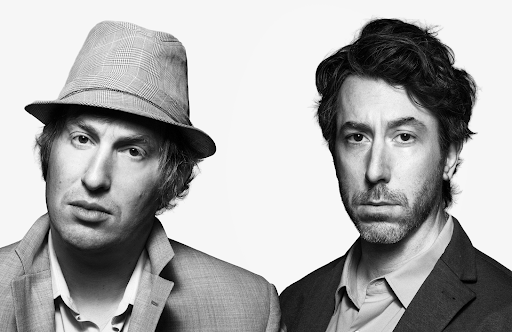
The film is the latest in a multimedia series created by real-life best friends Matt Johnson and Jay McCarroll. It’s a buddy mockumentary-style comedy which succeeds the web series (Nirvanna the Band the Show), which follows a fictionalized version of the two friends as they assemble a fake band and attempt to get booked at The Rivoli (a Toronto club).
It’s is a celebration of a style that has largely disappeared from mainstream media. The comedy relies almost entirely on pop culture references and situational humor. It is a return to a simpler style of comedy, similar to that made by early YouTubers who had little but their friends and a webcam. While it still has that “early internet” feeling, Johnson and McCarroll find a way to make it relevant. Meta 4th-wall breaking and seamless restitching of never before seen archival footage are used tastefully rather than shoved in the viewer’s face. The movie is almost entirely set in real Toronto locations, harkening back to the 2000s style of mockumentary filmmaking popularised by projects like “The Office” and “Borat.”
The plot deals heavily with time travel; however, the way time travel is depicted in the film is deeply satirical as opposed to overly pragmatic. Instead of making up a scientific explanation of how time travel works, they comedically steal the system that was set up in the “Back to the Future” film series. While the film takes many absurdist twists, it never dwells on anything happening on screen. The rules of the world bend to whatever the directors thought was funny.
The film impresses by being a low-budget guerrilla-style mockumentary ($2 million budget) with spectacularly complex set design. With a very small crew, most of the heavy lifting had to be done by the Johnson and McCarroll themselves. This includes the duo managing to redesign the downtown area of Toronto to look as it did in 2008 largely through using the aforementioned archive footage.
The bulk of the film is about a stagnant relationship between friends. While this premise is hardly new, Johnson and McCarroll present an interesting approach: instead of being equal in their treatment of the characters’ potential for success, the creators say outright that Jay is the only one of the two who has any chance at making it.

This becomes clear when the pair meet their 2008 selves in an attempt to obtain more Orbitz (a Canadian soda) to power their time machine. When Jay reveals he had the opportunity to go solo, Matt, in a fit of rage, erases the original plans they had made in 2008 so that the duo will split up in the future. In the present, Jay is faced with enormous success: he becomes the most famous Canadian ever, while Matt is reduced to being the drummer in a Jay McCarroll Cover Band.
Despite the success he once yearned for, Jay realizes that the reality of fame is dull, since without his other half, he lacks understanding and comfort. This feeling climaxes when he accidentally kills one of his tour bus acquaintances while trying to reenact a game he used to play with Matt. Embracing this new reality feels, to Jay, like embracing a form of death. When he was with Matt, the world remained novel: they were constantly on the verge of “making it.” Because of that, he could live in bliss where finality was far away. But once he acquired what he thought he wanted, there is finality; he no longer exists in a world where his opportunities feel limitless.
Although Jay and Matt are supposed to be in their 40’s in real life, the movie never mentions that they have been trying to make it as musicians for nearly 20 years to no avail. This is because their friendship is a representation of hope in the face of death.
The movie ends with them back where they started. However, it doesn’t feel unresolved; instead, it feels as though a sense of hope has returned, much like they had in 2008. That year, presidential candidate Barack Obama’s motto was “hope and change,” and Matt and Jay certainly deliver the hope part, even if they still couldn’t get that spot at The Rivoli. The journey proves to be far more fruitful than any destination ever could.
Regions: Boston