
Beyond the Frame: When Video Art Rewrites the Language of Cinema
From video art’s emergence in the late 1960s, it has sparred in a productive tension with cinema, simultaneously appropriating and dismantling film’s conventions. Early pioneers such as Nam June Paik, who transformed television into sculptural architecture, Bruce Nauman, whose closed-circuit videos foregrounded surveillance, and Joan Jonas, who fused performance with myth, all redefined the screen as a physical and experiential space rather than a transparent narrative window. This expanded cinematic grammar saw further development by artists such as Douglas Gordon, whose temporal manipulations of Hollywood films fractured narrative time; Sam Taylor-Wood, who merged painterly stillness with cinematic duration; and Stan Douglas, whose meticulously constructed filmic installations interrogated history, memory, and the mechanics of storytelling.
Artists including Shirin Neshat and Eija-Liisa Ahtila expanded cinema into multi-screen and spatial narratives, fragmenting perspective into psychological, political, and gendered planes , while Doug Aitken shaped moving images into immersive environments that collapsed architecture, sound, and motion. Alongside them, Pierre Huyghe destabilized authorship through open-ended cinematic systems, and Tacita Dean reaffirmed the temporal poetics of analogue film, positioning cinema as a fragile, time-based object rather than a vehicle for plot. Together, these practices established a new visual language where the screen no longer served merely a site of projection but a sculptural, architectural, and conceptual threshold — a legacy that directly informs contemporary video art practices seen today.
While museums play a critical role in the promotion of video art by providing the curatorial framework necessary to exhibit time-based works, major international art fairs concentrate the most relevant contemporary artistic practices, operating as temporary laboratories where artists working across video, cinema, photography, sculpture, performance, and digital media display projects side by side, allowing visual languages to intersect and influence one another in real time.
This was my experience after attending Art Basel Paris 2025 at the end of last year, and more recently Mexico City Art Week 2026. At both art fairs, the relationship between the viewer and image no longer seemed frontal or passive. The viewer doesn’t watch the work, but rather circulates through it, brushes past it, feels its sound vibrate against stone, steel, or temporary walls. Cinema, fractured and redistributed, leaks into space.
In Paris, this shift between viewer and image felt immediately palpable. Inside historic chapels, provisional pavilions, and gallery booths carved into the Grand Palais, screens floated and embedded themselves into sculptural frameworks, becoming objects, no longer illusions. Projection was not an end but a material gesture.
This approach marks a decisive break from classical cinema’s illusionism. The screen no longer disappears to reveal a story. It asserts its presence, the image acknowledges its own construction — its duration, its loop, its fragility.
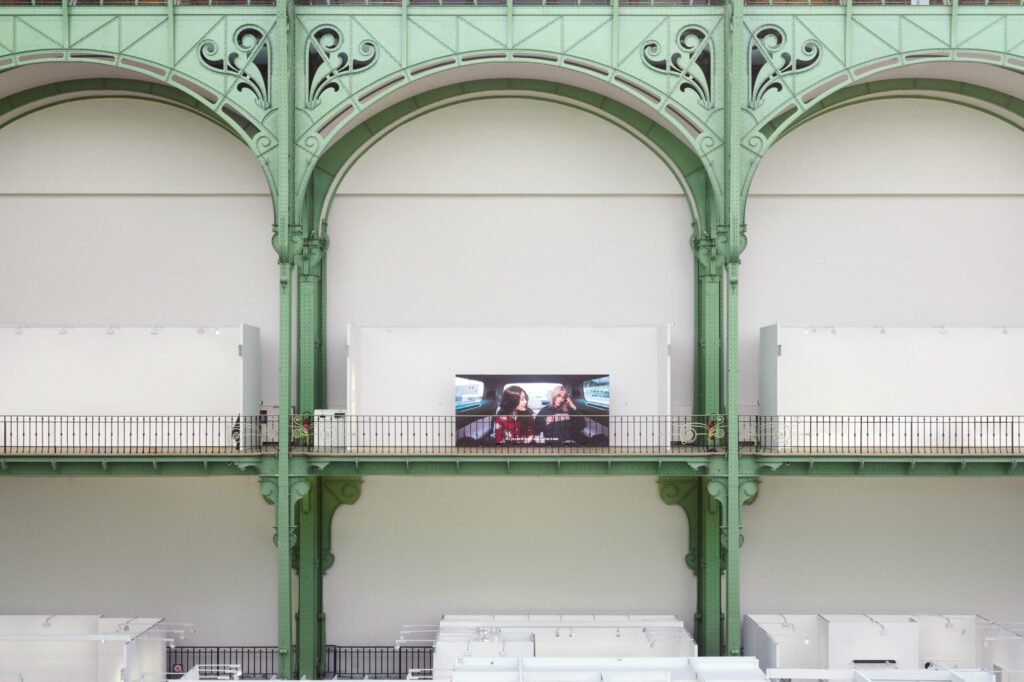
One notable video and moving-image work featured at Art Basel Paris 2025 came with “New Energy” (2025) by Siyi Li, presented in the Emergence sector by Cibrián gallery. Born from the artist’s desire to turn his solitary practice into a conversation (several people participated in the making of this short film, from the actors on screen to professionals behind the camera), this video work plays like a series of cinematic vignettes exploring movement, identity, and contemporary visual culture—marrying the rhythms of cinema and the immediacy of digital image flow.
At Offscreen Paris, the satellite program that values experimental image-based practices, video art moved from the margins of contemporary practice into a realm of critical and historical dialogue. Inside La Chapelle Saint-Louis de la Salpêtrière — an atmospheric, candlelit precinct once reserved for sacred rites — the moving image became the primary language, a summary of the long arc of video history: here Richard Serra’s 1973 “Television Delivers People,” a prescient critique of media consumption, sat side by side with experimental works by Annegret Soltau.
A pioneering figure of the German feminist avant-garde, Soltau’s multiple media practice expanded into performative video works and installations. Her central concerns, feminism and body politics, found articulation through her pioneering techniques of “photo-sewing” and “photo-restitching,” which physically disrupted the photographic surface. Her self-portraits challenged normative representations of femininity and made visible emotional tension, psychological depth, and social constraint. These works, nestled amongst historic prints and early chronophotography, underscored video’s lineage from scientific curiosity to conceptual force—dreams taking material form.
Mexico City would echo this logic months later with Zsonamaco, Material Art Fair, and Salón ACME. The city’s physical intensity — its scale, its noise, its layers — seemed to demand this expanded cinematic language.
At Zsonamaco 2026 I came across the work of Rafael Lozano-Hemmer, an artist who situates the moving image within systems of surveillance, data, and public space. His large-scale video piece titled “Pulse Agglomerate” records a biometric performance presented during the 60th Venice Biennale (2024). The work took the form of a wearable structure carrying hundreds of lightbulbs, each flickering to the recorded heartbeat of a past participant, as the performer moved through the streets of Venice collecting one hundred heartbeats, replacing the cinematic spectator with an active participant whose presence — breath, heartbeat, movement — literally generates the work.
Drawing on cinematic devices such as projection, sequencing, and immersive sound, Lozano-Hemmer dismantles the notion of the screen as a fixed site of reception and transforms it into a responsive interface. In doing so, he pushes cinema toward a collective, networked experience where authorship gets distributed and perception finds shape in real-time interaction rather than narrative progression.
At Material Art Fair 2026 Greg Gangemi, a 3D artist and director based in NYC turned inward, using video to explore psychological states and the mechanics of perception. His experimental video and playful CGI explorations often adopt cinematic pacing, framing, and sound design, yet resist linear storytelling in favor of repetition, fragmentation, and subtle temporal shifts. Gangemi’s videos function like suspended moments — closer to mental images than cinematic scenes — mirroring memory and internal reflection. In this way, his practice aligns with a broader tendency in contemporary cinema toward interiority, where meaning emerges from sustained attention and emotional resonance.
As part of the same art fair, Kiani del Valle presented a body of short video works that situated cinema firmly within the language of the body. Trained as a dancer and choreographer, del Valle uses the camera as an extension of movement rather than as a tool of documentation, drawing on cinematic framing, rhythm, and duration to construct tightly composed, sensorial experiences. In “COAYBAY” (2021), del Valle uses breath, water, and tightly framed movement to construct a cinematic language rooted in bodily rhythm rather than narrative progression, while “Sangre de Mi Sangre” (2022) compresses this approach into one-minute durations structured around pulse, proximity, and visceral intensity.
In these works, the body measures time — by blood, breath, and tension — positioning the camera as an extension of choreography and transforming cinema into a somatic encounter rather than a storytelling device. del Valle’s videos collapse distinctions between dance, performance, and film, foregrounding gesture, breath, and skin as primary carriers of meaning. The physical intensity and emotional immediacy of these works reinforced the broader shift toward embodied spectatorship at the Mexico City Art Week.
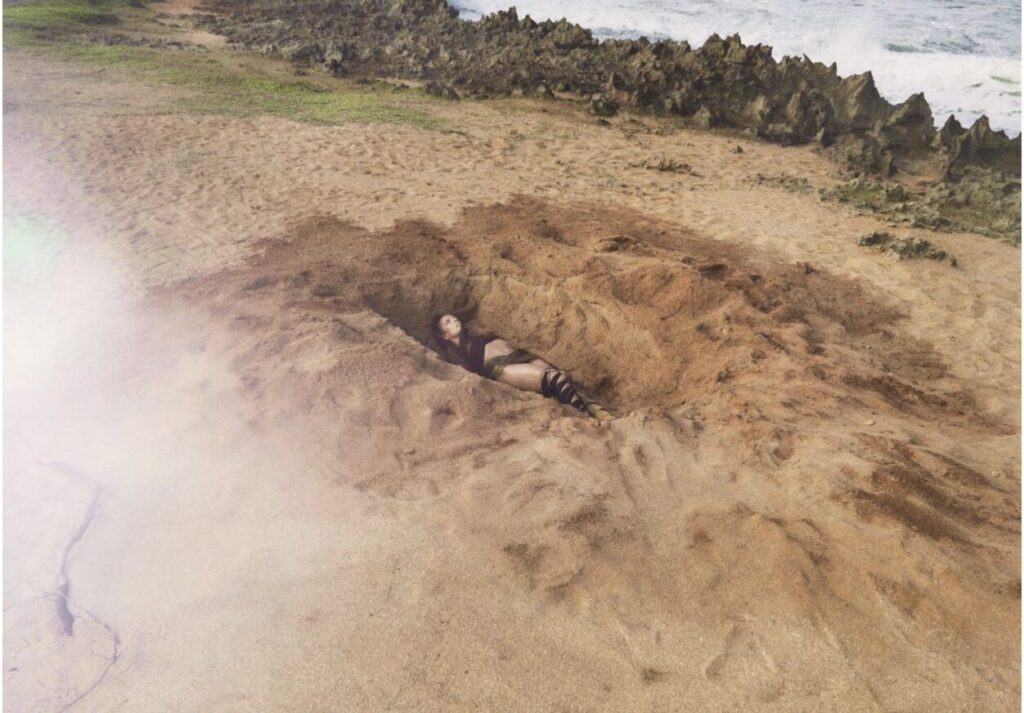
This focus on performative acts and embodied gestures underlines the city’s long-standing role as a site where everyday movement becomes a poetic language — a lineage that leads directly into the late-1990s turn toward urban performance. After all, in 1997, Francis Alÿs helped shape a performative urban vocabulary that resonated internationally when he pushed a large block of ice through the Mexico City streets for over nine hours until it melted completely. Titled “Paradox of Praxis 1 (Sometimes Making Something Leads to Nothing),” this act served as a metaphor for the inefficiency of labor, highlighting the region’s economic injustices.
This same city saw Bill Viola return the moving image to ritual space. His 2022 exhibition at the former convent church Ex Teresa Arte Actual reaffirmed the site’s resonance as a convergence of image, sound, and architecture. The show centered on the human condition, emotional states, and the passage of time through slow-motion imagery. The exhibition included major pieces such as: “Fire Woman” (2005), “Tristan’s Ascension” (2005), “Ablutions”, “Surrender”, “The Greeting”, “Three Women”.
This year, the very same art space hosted British artist Maria Marshall’s retrospective during Mexico City Art Week 2026. From all the artists discussed in this article, her video work practice proves the most filmic. Marshall borrows from cinema by extracting and reworking its most symbolic tools. Framing, duration, choreographed movement, sound, and archetypal imagery produce emotionally charged sequences that feel filmic even when dispersed across an entire installation.
Her use of recognizable figures (the child, the church, the cowboy) in video works such as “Don’t Let the T-Rex Get the Children” (1999) and “Playground” (2001), echoes cinema’s reliance on shared visual codes, allowing meaning to surface intuitively. Like cinema, her work operates through time and atmosphere, guiding the viewer through states of tension, vulnerability, and transformation.
Marshall contributes a radical reconfiguration of spectatorship back to Black cinema. By dispersing filmic elements across architectural space and live bodies as in “Cyclops” (2001-2002), she dissolves the fixed position of the seated viewer and replaces it with an embodied encounter in which physical emotion dominates cognitive interpretation.
Marshall’s narratives are fragmented, often withheld. Sensation takes precedence over story, pushing cinema toward a somatic experience. Her integration of performance, familial intimacy, and ritual transforms imagery into lived experience, expanding cinema beyond the screen into a spatial, bodily, and affective field — where the image pushes beyond representation to generate emotionit in the viewer.
This radical reconfiguration of spectatorship is part of a broader trajectory in video art and expanded cinema that has unfolded over several decades. Artists such as Douglas Gordon, Eija-Liisa Ahtila, Doug Aitken, and Pierre Huyghe have all displaced the passive viewer by turning exhibition spaces into immersive environments where time, movement, and perception lose stability.
What distinguishes Marshall from these other artists mentioned above is where that reconfiguration operates. Rather than focusing primarily on technological spectacle, architectural scale, or conceptual systems, Marshall grounds spectatorship in psychological, emotional, and bodily identification. The viewer is not overwhelmed or disoriented; instead, they are subtly implicated. Emotion is redirected into the spectator’s own body through intimacy, repetition, and vulnerability — particularly via the presence of children, maternal anxiety, and ritualized gestures.
Her work also diverges from many expanded-cinema practices in its integration of spiritual and somatic processes. By drawing on meditation, Marshall introduces a mode of viewing less about interpretation and more about attunement. The spectator is not positioned as analyst or witness, but as participant in a perceptual state.
While the destabilization of spectatorship is not unique to her, Marshall’s contribution lies in shifting cinema from spatial immersion toward emotional inhabitation, offering a deeply transformative model of how cinema can be experienced beyond the screen.
Many emerging and mid-career filmmakers are now doing in cinema what artists like Maria Marshall have long explored in video art: regenerating classical spectatorship toward embodied experience. Filmmakers such as Apichatpong Weerasethakul dissolve narrative causality in favor of atmosphere, encouraging viewers to inhabit time rather than follow plot — a strategy deeply aligned with installation-based video practices. Bi Gan uses durational takes and dream logic to create cinema that feels spatial and interior, positioning the spectator inside a psychological landscape rather than before a story.
Directors like Claire Denis and Jonathan Glazer foreground sensory disorientation, often withholding narrative clarity to produce visceral responses. More recently, filmmakers such as Gaspar Noé and Charlotte Wells have reoriented cinema toward affective immersion — Noé through sensory overload and spatial destabilization, Wells through emotional projection that invites the spectator to complete the film internally.
Cinema increasingly absorbs lessons from video art and installation: fragmented narration, attention to duration, and the prioritization of embodied perception over storytelling resolution. In this sense, contemporary filmmakers are not merely influenced by expanded cinema — they actively translate its strategies back into the theatrical space, collapsing the historical divide between gallery-based video art and cinematic passivity.
Regions: Paris