
Neglecting the necessary: Was Koji Fukada’s ‘Nagi Notes’ an apolitical letdown?
With a body of work that varies from short films told from the point of view of a motel bed to a Zoom call reimagination of the Yalta Conference, Koji Fukada is like a Japanese Spielberg: no matter how many years in the industry or the decade of creation, Grand Theft Auto VI will be out before he bogs himself down to one particular genre.
In “Nagi Notes,” his fourth feature film to premiere at the Cannes International Film Festival, Fukada’s ability to balance scenery with auditory cues to construct an ambient and wonderfully narrow tone spoke to his level of expertise. While this synergy was beautiful to watch, it was the only aspect of the film that indicated a production helmed by a seasoned director.
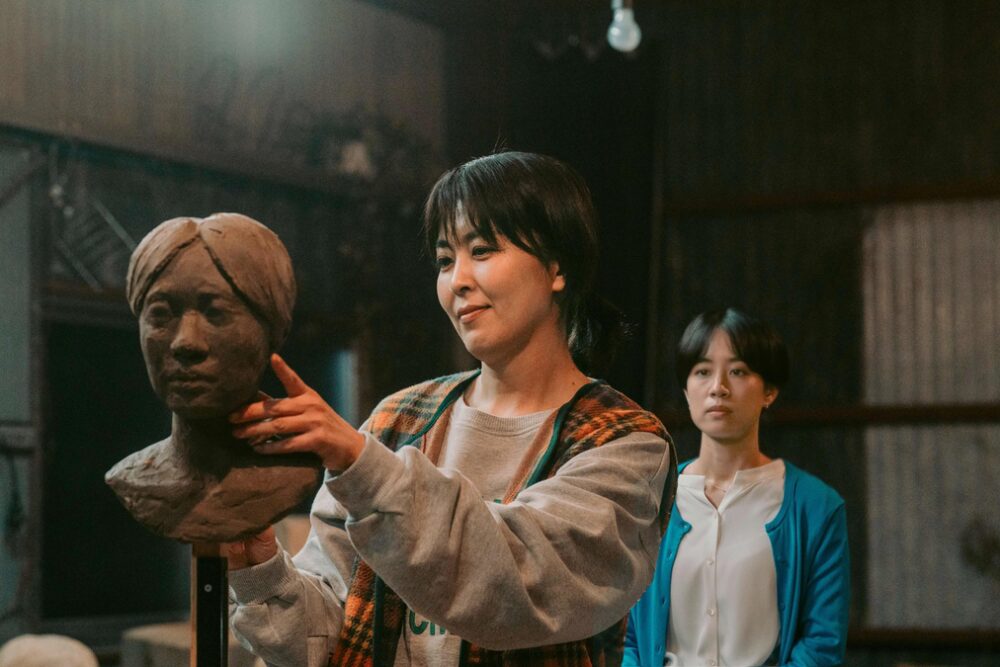
Set in the town of Nagi, a rural area located in the Katsuta District of Okayama, the film follows a recently divorced architect, Yuri (Shizuka Ishibashi), traveling from Tokyo to visit her former sister-in-law, wood sculptor Yoriko (Takako Matsu), to model for her latest sculpture. As Yoriko works, the two women reflect on past and present events: From Yuri’s divorce, Yoriko’s affair with a married woman, unrequited feelings and how to help two local children figure out love, the film at least does right by its title, reading as various notes from a book that might contain a full-fledged plot.
At first glance, it appears as if Fukada is taking a stab at a crônica-esque project, inspired by the Portuguese literary style of collaging seemingly unrelated short-form prose into a longform piece. If the film could be attached to one specific theme, it would be ownership. Due to the marriage of both of her love interests, Yoriko acknowledges her companionship with the two women without the typical account of ownership often ascribed to marriage as an institutional commitment.
In one line, Yoriko questions the integrity of architecture, asking her old friend if all buildings are built for the pleasure of their owners. This happens while a radio broadcast on the bombing of Kyiv by Russian forces plays in the background — one of the strongest points of connective dialogue in the movie. The strength of the women’s dynamic dissipates in its forced attempts to be blindly atmospheric when the chosen characters and their respective storylines are deeply laden with complexity and context, Fukada’s inability to honor this in favor of a simplistic storyline feels disingenuous.
Fukada’s last feature, “Love on Trial,” feels like a setup for this theme of restrictions on connections. As it covers the commodification of entertainers in a parasocial context, “Nagi Notes” is an account of queerness in a limited space or from a limited perspective.
Due to how these concepts are relayed and conceived, the film could have been the backdrop for a subtly charged commentary on reductive conceptions of queerness in Japan, how rural areas in postwar Japan respond to land attacks in other areas, exclusion and privatization in the field of civic art or basically anything else. In the end, Fukada fails to execute this successfully due to a misfire of what to execute, pivoting in tone and presence too often to truly make its point as a quiet story.
Regions: Cannes