
The Wrong Kind of American: On ESPN’s “The Brittney Griner Story”
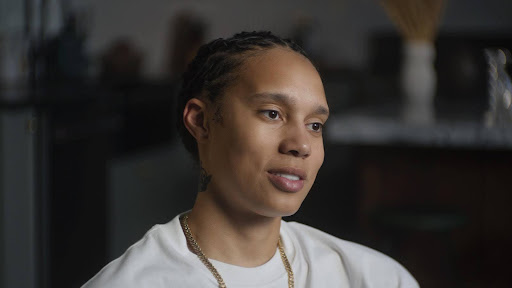
When WNBA star Brittney Griner was detained at a Russian airport in February 2022, after she was accused of traveling with vape cartridges containing cannabis oil, her wife, Cherelle Griner, became her unwavering lifeline. For 294 days, while Brittney was kept in a Russian prison, Cherelle and Brittney’s agent, Lindsay Kagawa Colas, fought tirelessly — galvanizing public attention, refusing to let Brittney’s story fade and ultimately turning a wrongfully detained athlete into a national priority. ESPN’s documentary “The Brittney Griner Story,” directed by Alex Stapleton, which premiered at Sundance this year, follows both the public campaign for Brittney’s release and what she endured to survive it.
The documentary opens not with Brittney’s childhood, but with her life as an established basketball star in Russia — a country where even international women players are treated as national icons. This starkly contrasts with the WNBA’s lack of visibility and pay equity, which is why so many American players go overseas in the first place. Brittney had been playing for Russia’s UMMC Ekaterinburg since 2014 during the WNBA offseason. After competing in the Olympics, Brittney made a quick trip home before returning to Russia. Packing in a hurry, she accidentally tossed medical cannabis vape cartridges — prescribed for chronic pain — into her suitcase.
The film uses security camera footage: Brittney being pulled aside, her bags inspected, the tiny cartridges laid out. The surveillance angle is cold and bureaucratic. She signs paperwork she can’t understand. The translator only tells her where to sign, not what she is signing. There is no lawyer. No explanation of her rights. She possessed less than one gram of hashish oil, an amount that, in Russia, carries a potential ten-year sentence. From the airport, Brittney was taken immediately to a detention center. Just one week later, Russia invaded Ukraine, turning a criminal matter into a geopolitical standoff. The war didn’t just change global politics: It made Brittney a bargaining chip.
Cherelle and Lindsay made ignoring Brittney impossible. The film tracks their campaign: basketball teams wearing Brittney’s number, fans demanding action at games, social media posts growing into an unrelenting flood of visibility. The women transformed grief into intentional organization. What started with two women refusing to be silent became a movement loud enough to reach the White House. President Biden appears in the documentary, speaking about why he chose to bring Brittney home. After meeting with Cherelle and Lindsay at the White House, he describes being moved by their determination and Brittney’s story. The U.S. government had officially designated her as wrongfully detained, and Russia would only agree to a one-for-one prisoner swap — Brittney for convicted arms dealer Viktor Bout — leaving Marine veteran Paul Whelan behind. The decision was driven by what Cherelle and Lindsay spent 294 days making impossible to ignore: Brittney’s humanity.
Inside, Brittney was fighting her own battle. The film follows her as she navigates the Russian legal system, a process her lawyers describe as fundamentally different from American courts — one with a 99% conviction rate. She was found guilty and sentenced to nine years in prison. The penal colony was brutal: forced labor, starvation rations, 23 hours a day confined to a cell with metal bars, freezing conditions so severe that Brittney’s locs froze solid and caused rampant tuberculosis.
Alex doesn’t dramatize by reenacting these conditions. Instead, she shows Brittney’s actual Sudoku book, the margins filled with prayers for strength, notes about missing her family, fear, anger and hope. The date always comes first, anchoring her to time. She marked each day so time wouldn’t dissolve completely. Then, she would write a few sentences.
Despite the language barrier, she formed small, but important, human connections with guards and fellow inmates. One guard even allowed her lawyer to FaceTime Cherelle briefly during her trial — a fleeting moment of grace.
The film shows how Brittney’s identity as a Black, queer woman made her a target from the start. When she was detained, she was wearing a ‘Black Lives for Peace’ sweatshirt — openly asserting who she was and what she stood for, even in a country hostile to both Black people and LGBTQ+ individuals. In Russia, where LGBTQ+ rights are virtually nonexistent and racial prejudice runs deep, her identity was weaponized against her. Brittney had paid Russian taxes for years, built relationships there, been embraced as a basketball star — yet none of it mattered when Putin needed a pawn.
On December 8, 2022, Brittney was finally released in a prisoner swap for Viktor Bout, a Russian arms dealer known as the “Merchant of Death.” The exchange was controversial — Paul Whelan, a Marine veteran also wrongfully detained in Russia, remained behind, and the backlash was immediate and vicious. But Cherelle’s response reveals everything about Brittney’s character: if Paul had been chosen instead of Brittney, she would have understood, because she believes all wrongfully detained Americans deserve to come home.
The documentary captures a remarkable moment during the exchange: when Brittney was taken off the plane in the UAE, she introduced herself to the officials facilitating the swap and thanked them, a gesture that even seasoned diplomats said never happens. Even in her own liberation, she made space to acknowledge the people who made it possible. The film goes on to show her reunion with Cherelle and the overwhelming relief of her family. After 294 days, she was finally home. But home didn’t mean safe.
The racism didn’t end with her release. The film captures the backlash: posts across social media, videos from Donald Trump Jr. expressing outrage that Brittney was freed while Paul Whelan — a white Marine, the “true” American hero — remained detained. Death threats started pouring in. The rhetoric was clear: she was the wrong kind of American to save, a product of “woke” priorities rather than someone who deserved freedom. Alex documents this ugliness without commentary, letting viewers reckon with its meaning.
Back home, Brittney wasn’t done fighting. She returned to basketball, working alongside teammates to address the pay gap that sent her to Russia in the first place, and continued building something better rather than accepting what exists.
Cherelle and Brittney also continue advocating for other Americans wrongfully detained abroad, working with families who are still fighting for their loved ones to come home. Paul Whelan remains in Russian custody, and others like him are still waiting to be released.
As a filmmaker, Alex knows when to step back. She lets the material speak for itself — centering Brittney’s own voice throughout. “The Brittney Griner Story” is advocacy filmmaking at its best. It is clear-eyed about injustice and cares about the people it follows. The film doesn’t just document what happened to Brittney Griner — it continues the work Cherelle and Lindsay started, bringing her story to wider audiences and asking the hard questions about whose freedom matters, who deserves to be saved and what we’re willing to fight for.
Regions: Salt Lake City