
‘Fjord’, a Masterclass in Film Manipulation
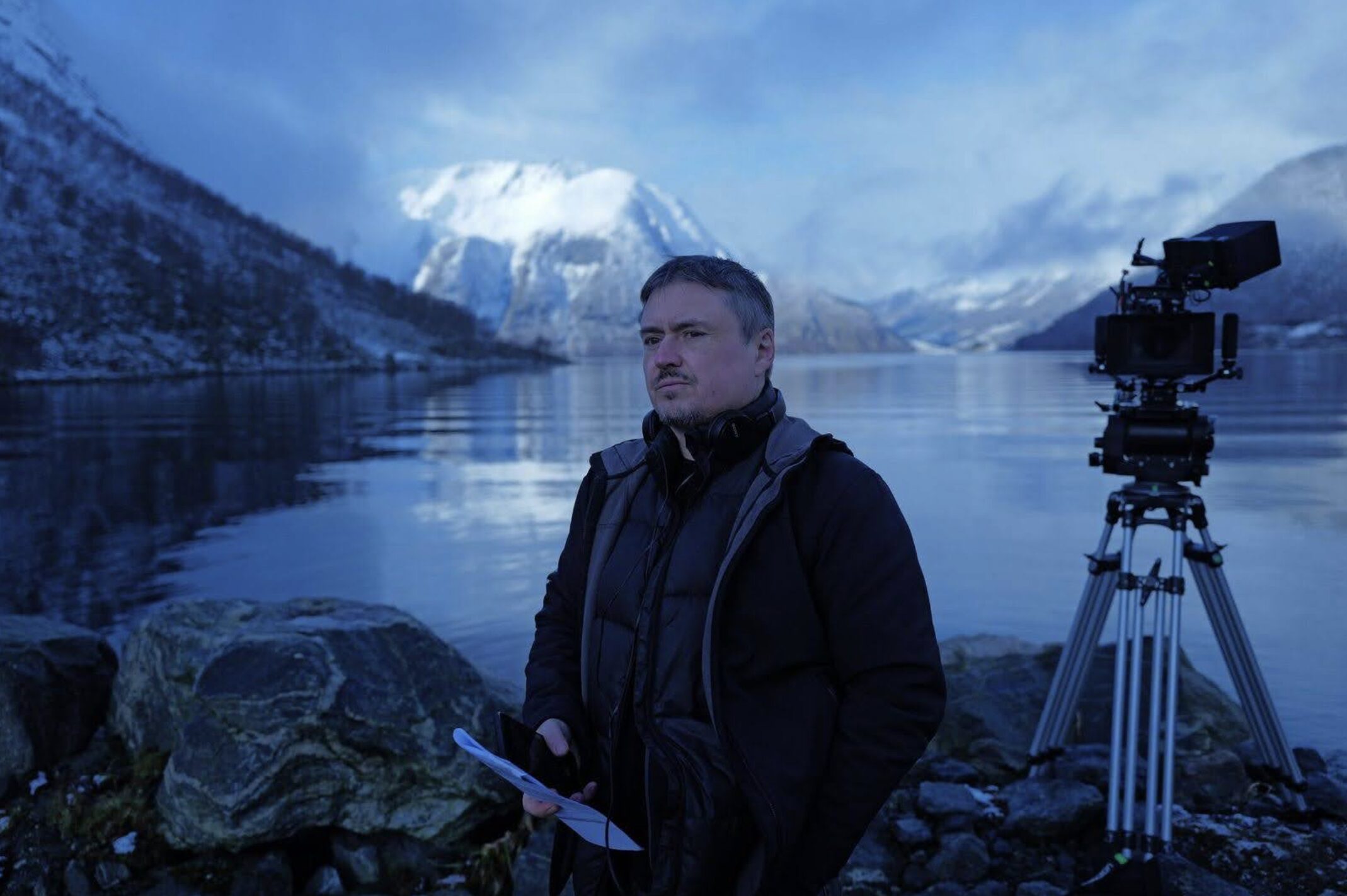
This year’s Palme d’Or winner, “Fjord,” directed by Cristian Mungiu, is one of the most incendiary films I have seen in years and guarantees to provoke fierce debate. Built around insinuations of a family abusing their children, the film gradually blurs the lines between religious and cultural persecution and child welfare concerns.
Mungiu first conceived the project nearly a decade ago, when several controversial child-protection cases involving Norway’s Barnevernet agency began attracting international attention. He followed these cases for years, eventually drawing inspiration from the highly publicized Bodnariu affair. Despite years of development, the film’s release timing could hardly be more apt. “Fjord” opens up a difficult conversation at a moment when tensions between progressive and conservative worldviews have reached unprecedented heights across Europe.
Throughout his career, Mungiu has built his reputation making films that methodically interrogate authoritarian systems — ranging from the state and the church to healthcare and education. His 2007 Palme d’Or-winner, “4 Months, 3 Weeks and 2 Days,” remains one of the defining films of post-communist Romanian cinema, admired both for its technical rigor and its devastating critique of institutional power. Across his filmography, Mungiu has shown a recurring fascination with bureaucratic violence: the ways institutions reduce complex human realities to procedures, reports and administrative categories, while preserving a self-image of ethical legitimacy.
At first glance, “Fjord” appears to fit comfortably within these long-standing authorial concerns. Once again, we seem to encounter administrative opacity, moral paternalism, institutional gaslighting and citizens rendered powerless by systems that speak in the language of care. Yet, the film also marks a notable shift. Whereas Mungiu’s earlier targets were often overtly authoritarian structures, here he turns his attention toward a liberal-democratic institution that enjoys broad public trust. As he openly acknowledged during the Cannes press conference, one of the film’s ambitions is to examine what happens when progressive ideology itself becomes the new orthodoxy and begins to function as another form of authoritarianism.
In that sense, “Fjord” presents Mungiu with a new challenge: not exposing authoritarianism where audiences already expect to find it, but locating it within a society widely regarded as one of the world’s most humane and enlightened. The choice of Norway is therefore no accident. Long held up as a model social democracy, Norway prides itself on its commitment to equality, minority rights and child welfare. It is precisely these last two aspects that “Fjord” places under scrutiny.
The film follows the Gheorghiu family who relocate from Romania to a remote Norwegian fjord town. Mihai, a Romanian IT engineer, and his Norwegian wife, Lisbet, are deeply religious and raise their five children within a strict fundamentalist framework centred on Bible study, daily prayer and the rejection of many aspects of contemporary secular culture. Their arrival is initially met with warmth by their Norwegian neighbours, the Halbergs, whose daughter quickly befriends the Gheorghius’ eldest child, Elia.
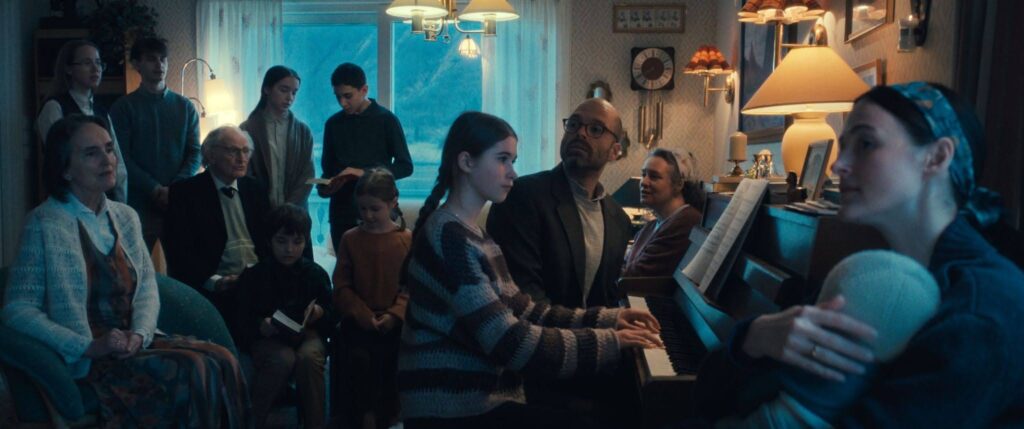
The harmony proves short-lived. When Elia arrives at school with visible bruises, teachers alert child-protection authorities. During questioning, Elia and her brother casually admit that their parents sometimes discipline them physically, with a slap on the bottom. Mihai himself acknowledges using occasional corporal punishment, seeing it as a normal and biblically sanctioned parenting practice. In Norway, however, such practices are illegal. Child-protection services intervene, removing the children from their home while an investigation is conducted. As legal proceedings unfold, the case gradually expands beyond the question of physical discipline and becomes, at least from the family’s perspective, a broader examination of their religious convictions and way of life.
At Cannes, Mungiu described “Fjord” as a “sophisticated and balanced” exploration of “the limits of intimacy and freedom.” He also framed it as a story about “what happens when one’s values fail to align with those of the society in which one wishes to live.” Both descriptions are revealing. The film is undeniably concerned with the trauma experienced by a family whose private life is abruptly exposed to public scrutiny. Yet these formulations also point toward the central tension at the heart of the film: Is it an investigation into possible abuse, or an examination of what happens when liberal institutions confront conservative beliefs?
The answer matters because the film’s considerable power derives from how it encourages us to interpret that question. And it is here that “Fjord” becomes both fascinating and, in my view, deeply problematic. What ultimately makes “Fjord” troubling is not that it questions Norway’s child-protection system — cinema should absolutely interrogate institutions, especially those that exercise power over private lives. The problem lies in how the film distributes uncertainty. And my main point is that the film distributes uncertainty asymmetrically.
Mungiu grants the Gheorghiu family full phenomenological reality. We witness their daily routines, moments of tenderness, contradictions and vulnerabilities. We come to know them as complete human beings. Even the slap that triggers the investigation is woven so seamlessly into the choreography of daily domestic gestures that it barely registers as a rupture. This is cinematically powerful because it reflects how violence within families often appears: normalized and intermittent, embedded within affection rather than presented as spectacle.
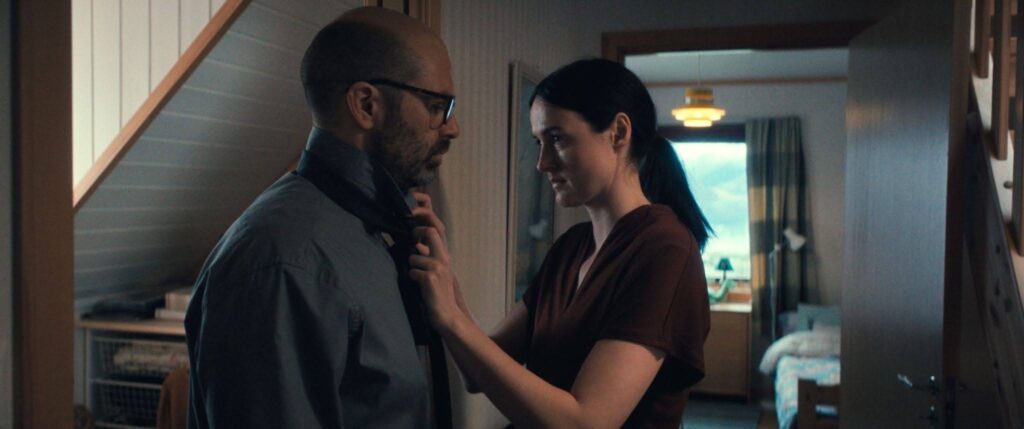
Yet, the effect is also persuasive. Because the audience experiences events almost entirely from within the family’s emotional ecosystem, it relativizes the act itself.
The child-protection workers receive no comparable treatment. They exist largely within procedural spaces — offices, hearings, interviews — and are rarely shown outside their institutional roles. They become embodiments of bureaucracy rather than individuals confronted with impossible ethical dilemmas. The result is a profound asymmetry of humanization: the family is individualized while the institution is abstracted.
This asymmetry matters because child-protection systems operate under conditions of radical uncertainty. A bruise exists. Children make statements. Corporal punishment is illegal in Norway. The authorities do not possess omniscience; they must act without certainty. Their task is structurally tragic: intervene too late and a child may remain in danger; intervene too early and an innocent family may suffer profound trauma.
The film acknowledges the family’s uncertainty — “they don’t know us, yet they are destroying our lives” — but largely ignores the institution’s uncertainty: “We do not know whether these children are safe, therefore we cannot simply trust appearances.” These are fundamentally different epistemological positions, yet only one is granted emotional legitimacy. The irony is that “Fjord” draws inspiration from real controversies surrounding Norway’s child-protection services, where such systems are built around prevention rather than retrospective knowledge.
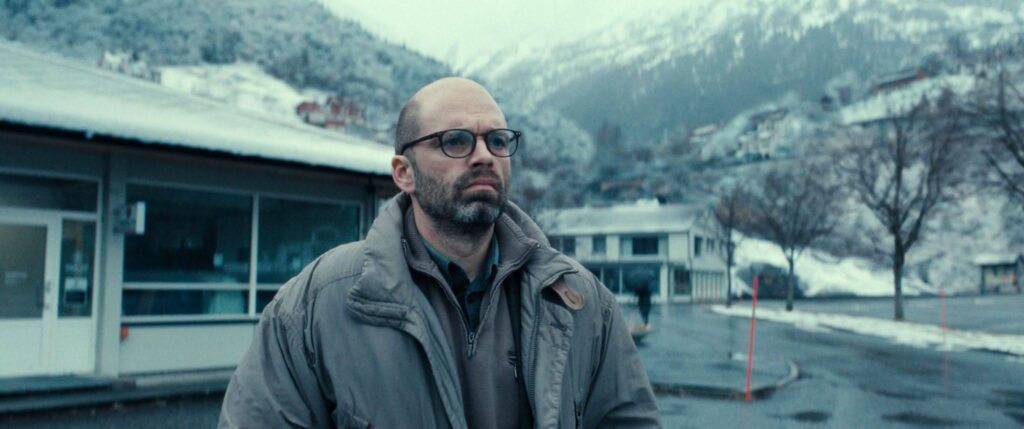
A courtroom exchange crystallizes the issue. When the employee who reported the case is asked whether she is a mother herself, she replies: “No, but I’m very good at my job.” The implication is striking. Professional judgment is subtly positioned against parental experience, institutional competence against supposedly “natural” forms of care. Yet child-protection systems exist precisely because families are not always protective. The opposition itself is misleading and the question is morally problematic, as if professional competence without maternal experience were somehow deficient, illegitimate or inhuman. The generalized implication is very serious: It would delegitimize any profession requiring judgment about children unless one had a biological claim to that profession.
Even more revealing is what the film itself shows. The children are not depicted as traumatized by the authorities; if anything, they appear safe and cared for. The suffering is concentrated almost entirely in the parents’ experience of dispossession — the loss of intimacy, authority and control. Gradually, the film’s moral center shifts away from child welfare and toward parental rights.
Mungiu has described “Fjord” as a film about what happens when one’s values clash with those of the society in which one wishes to live. This framing further complicates the film because it subtly transforms a child-protection investigation into a conflict of worldviews. Once the story is understood primarily as a clash between progressive secularism and conservative religiosity, the authorities begin to appear ideologically motivated rather than legally obligated. It’s almost as if the story contains its own (and sole) interpretation.
The film reinforces this interpretation through numerous contextual cues. Norwegian society is coded as secular, progressive and liberal, while the Gheorghius embody religious traditionalism. The audience is therefore encouraged to suspect that the intervention stems less from concern for the children than from hostility toward a worldview deemed incompatible with contemporary social norms.
This is a legitimate tension for cinema to explore. Liberal democracies do struggle with the limits of tolerance toward illiberal beliefs. But “Fjord” often blurs two distinct questions: whether progressive societies can become culturally intolerant toward conservative minorities, and whether child-protection intervention is therefore ideologically corrupted. These are not the same question.
A truly tragic version of this story would have forced the audience to inhabit two incompatible truths simultaneously: the family’s experience of the intervention as catastrophic and invasive, and the institution’s fear that non-intervention could prove catastrophic as well. Instead, the film settles the emotional question long before it earns the epistemological right to do so.
What is fascinating is that Mungiu achieves this not through an overt polemic (although some critics did perceive the film as some sort of “debate club”), but through the cinematic form itself, proving once again what a master filmmaker he is. The film is, I dare say, a masterclass in cinematic manipulation.
One of the earliest and most effective forms of audience manipulation appears before the film even begins:
1) The film poster itself. Long before we are introduced to the Gheorghiu family as characters, we encounter them as an image. The promotional artwork presents an idyllic family portrait: smiling faces, physical closeness, warmth and domestic harmony. Even the patriarch, who later reveals a stern and disciplinarian side, is photographed in soft, flattering light. The image preconditions the viewer’s sympathies from the outset.
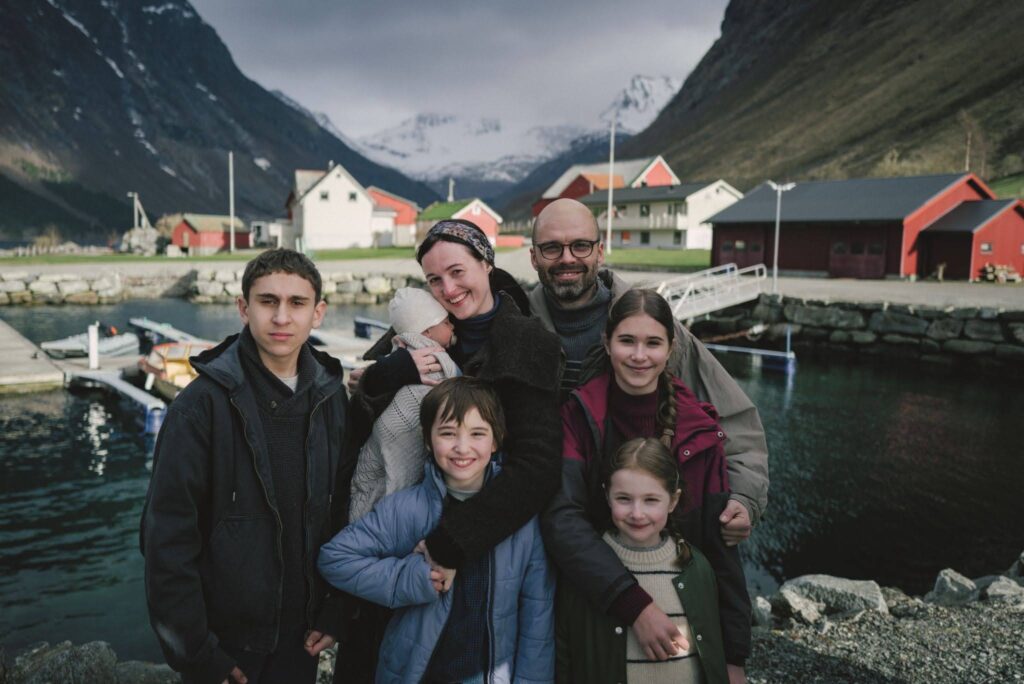
This becomes particularly significant because the allegations are ultimately directed not at the father but at the mother. Had suspicion fallen primarily on Mihai, the father, the film might have generated greater moral uncertainty, allowing the audience to question a character whose authority and rigidity are visible from the start. Lisbet, by contrast, is presented as almost impossibly reassuring. Renate Reinsve’s wide-eyed features, combined with the character’s headscarf, gentleness and aura of maternal devotion, create an immediate impression of innocence. She radiates tenderness, wholesomeness and vulnerability to such a degree that she appears almost beyond suspicion. Before a single piece of evidence is presented, the audience has already been encouraged to view her less as a possible subject of investigation than as its likely victim.
2) Realism as a persuasive tool
Secondly, the film’s realism becomes one of its most powerful persuasive tools. Many films create the impression that what we’re seeing is simply reality. Long takes, naturalistic performances, location shooting, restrained music and observational camerawork create the impression that we are simply witnessing reality unfold. Yet, realism is never neutral. By controlling perspective, information and emotional access, the film quietly guides the audience toward a preferred interpretation.
3) Emotional Sequencing
This refers to the persuasive way the film organizes emotional experience. Again and again, we are invited to witness the family’s suffering: the shock of separation, the humiliation of being investigated, the anguish of losing access to their children. The performances are notably restrained, but restraint should not be confused with neutrality. Mungiu has always favoured an observational, anti-didactic style, which often creates the impression that he is merely presenting reality rather than guiding interpretation. As a result, critics frequently describe his films as morally open-ended even when their cumulative emotional direction is quite clear. Something similar happened, albeit to a lesser degree, with “4 Months, 3 Weeks and 2 Days”; its formal detachment led some reviewers to call it “objective,” despite the film’s overt indictment of authoritarian power. In “Fjord,” the understated performances and naturalistic presentation can likewise obscure how carefully audience sympathies are being directed.
4) Dialogue Framing
Dialogue is never distributed equally in “Fjord.” The family receives far more screen time and significantly more opportunities to articulate its worldview, fears and frustrations. We hear lengthy conversations about faith, parenting, family life and the emotional consequences of the investigation. The authorities, by contrast, often speak through institutional language: legal formulas, procedural explanations, official assessments. As a result, the family’s speech appears rich, personal and emotionally authentic, while the institution’s speech appears cold and bureaucratic. The imbalance encourages viewers to perceive one side as fully human and the other as merely administrative. The issue is not simply the quantity of dialogue but the quality of access it provides.
5) Casting
Casting itself functions as a powerful interpretive tool. Audiences inevitably bring assumptions and emotional associations with them into the cinema. Renate Reinsve, whose international reputation was established through “The Worst Person in the World,” possesses a screen presence that naturally generates empathy. Her performance here emphasizes warmth, vulnerability and emotional openness. Even before the narrative asks us to evaluate her actions as a parent, the film has already benefited from the audience’s instinctive trust in her. The casting of Reinsve subtly reinforces the film’s broader tendency to position the family as sympathetic long before the moral questions at the centre of the story have been fully examined.
There was an interesting irony during the Cannes press conference. Renate Reinsve revealed that she had received the script only three days before filming began, leaving her little time to fully prepare for or absorb the complexities of her character. This perhaps helps explain why her interpretation of the role seemed, at least to me, strikingly different from the film that ultimately appeared on screen. Discussing Lisbet, Reinsve said: “It was very scary to play someone who was doing something wrong, and was violent without knowing it. It’s something I couldn’t completely understand, but I think it’s very important, because a lot of domestic violence is invisible to the people who do it. But what if someone discovers it? … I think this dynamic is very, very important to focus on, because within a family, you also create a citizen that will come out in society and behave towards others the way they learn to behave at home.” What is fascinating about this statement is how strongly it emphasizes a dimension that the film itself seems reluctant to foreground. Reinsve speaks of unconscious violence, the invisibility of abuse and the social consequences of harmful behaviour learned within the family. Yet these themes never felt fully developed in the finished film.
6) Lighting and Color
Visual design shapes emotional responses long before viewers consciously register narrative information. Throughout “Fjord,” the family is frequently associated with warmth, intimacy and organic domestic spaces. Interiors are often illuminated by soft natural light, creating a sense of comfort and familiarity. By contrast, many institutional settings are characterised by cleaner lines, cooler tones and more austere environments. The contrast is not extreme, but it is persistent. The family home feels lived-in and emotionally textured; offices, meeting rooms and courtrooms feel impersonal and procedural. The visual language quietly reinforces the film’s central opposition between intimate human experience and bureaucratic authority.
7) Editing
Editing may be cinema’s most powerful moral instrument because it determines not only what we see but what we do not see. In “Fjord,” crucial decisions are often made off-screen — crucial events unfold off-screen also — while the emotional consequences of those decisions are shown in detail. We witness the family’s confusion, grief and helplessness, but we are given comparatively little access to the deliberations that lead authorities to act. This creates a structural imbalance in the audience’s understanding of events.
The effect recalls the famous Kuleshov principle: viewers instinctively construct meaning from the relationship between images placed next to one another. When scenes of bureaucratic intervention are repeatedly followed by scenes of parental suffering, spectators naturally infer causality and moral responsibility. The emotional logic becomes stronger than the informational logic. Even when the authorities may have legitimate reasons for their actions, the editing continually returns us to the visible human cost of those actions.
8) Point of View and Information Control
Perhaps the film’s most significant persuasive strategy is its control of perspective. Nearly every important event is filtered through the Gheorghiu family’s experience. We know what they know, fear what they fear, and suffer when they suffer. The authorities remain comparatively opaque throughout much of the narrative. Their uncertainties, internal disagreements and ethical dilemmas receive far less attention than those of the parents.
Cinema does not necessarily persuade by changing the facts; more often, it persuades by determining from whose position those facts are experienced. Once viewers become emotionally aligned with a particular perspective, moral judgments tend to follow. The audience is not instructed to side with the family. Rather, it is placed so consistently inside the family’s emotional reality that alternative interpretations become increasingly difficult to sustain.
This is why I found “Fjord” less morally ambiguous than emotionally coercive. Some of Mungiu’s earlier films, particularly “4 Months, 3 Weeks and 2 Days” and “Graduation,” denied viewers the comfort of a privileged perspective. Here, by contrast, “Fjord’s” manipulation lies not in overt ideological messaging but in its unequal distribution of subjectivity; the result is a film that feels more accusatory than exploratory.
In the end, this is what weakens the film. Had Mungiu engaged more seriously with the possibility that the parents might be causing harm without fully recognising it — a possibility suggested by Renate Reinsve herself — “Fjord” could have achieved the moral ambiguity that would have made it truly powerful.
Instead, the parents are framed overwhelmingly as victims, and the film steadily guides the audience toward a single emotional and moral position. In a work that draws on real child-protection controversies, such an imbalance carries ethical implications that extend well beyond the boundaries of cinema.
And there is a final irony here, Mungiu has built his career exposing the dangers of institutional certainty and authoritarian thinking. But cinematically speaking, isn’t a film that tells us what to feel and think a form of authoritarianism too? In this sense, “Fjord” risks reproducing a version of the very phenomenon it seeks to critique. By directing empathy and moral legitimacy so overwhelmingly toward one side of the conflict, it operates less as a genuinely exploratory work of cinema than as an act of ideological provocation.
Regions: Cannes