
Playwright and Director Ashley Monet Long Discusses Explosive Debut, ‘Jamie Has A Bomb’
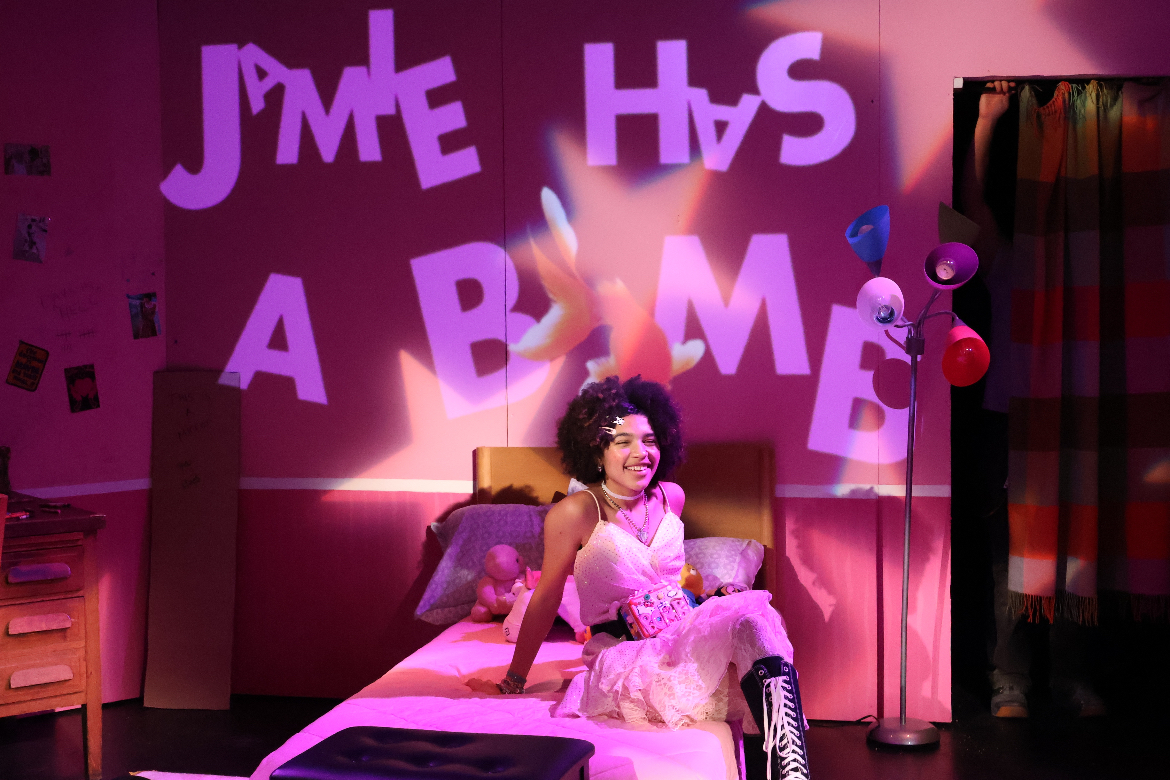
A sky-tearing student debut hit Emerson College theaters in late November, leaving shrapnel trails of tears and tough-ribbed theatergoers in its wake.
Written and directed by Ashley Monet Long and produced by Emerson’s own Mercutio Troupe, “Jamie Has A Bomb” centers the eclectic and mechanically-apt teenager Jamie (Maya Smith), who builds a bomb with the intent to self-detonate, and her pet goldfish Judas (Darrell Mondaine), who becomes determined to prevent her untimely suicide.
The three sold-out shows were performed on Saturday, Nov. 22 and Sunday, Nov. 23 in Emerson’s Judee Wales Watson Theater, affectionately named after the actor and alumna. Following its opening run, The Independent spoke with Long about picking up the pen, the urgency of theater by and for people of color and the hope that drives it all.
ASHLEY DAVIS: Where are you sitting emotionally following the closing of your debut?
ASHLEY MONET LONG: I feel good. I feel good that the process was good. I found myself being able to, like, break rules — tiny ones — and realizing we can really do whatever we want. I feel a little sense of relief because senior year is hard, but I feel like I can float away from the show and be like, “You did exactly what you needed to do.”
AD: I was speaking with a couple audience members after the show, and they noted how heavy the subject matter really was, even though they were laughing throughout. What’s the power of comedy, for you?
AML: It’s a safety net for anything. Comedy is based in play, and play is what we need to figure out who we are as people, how we interact with the world and each other. There’s levels to how we meld comedy in with our trauma and the hard things we go through in life, but it makes it easier for you to talk about things when you laugh at them. That’s a physical release, you know? I think comedy just kind of allows us to be like, “I know what this is. I find this funny, and so do other people. Let’s just laugh about it — and then maybe let’s talk about it.”
AD: Was there any one experience from your own life that you pulled directly into this play?
AML: Oh, so many. The overarching situation, of course, but it was mostly in the language. The jokes and other things came from myself, or things that I found funny. Things my friends said, too; [Mondaine], one of his bits is [saying], “Have it on my desk by tomorrow!” and I was like,
“That’s one of the funniest things I’ve ever heard. I’m putting it in.”
AD: To your cast, what did Maya [Smith] bring to the role of Jamie that you might not have noticed in the text itself? Did you learn anything about Jamie from Smith?
AML: With Jamie, I realized that I had to base everything around her, and what Maya brought that no one else brought is that she moved like a cartoon character. I didn’t even think about it when I was writing it. Jamie’s 18 and [Smith] is 18, and I think that made me realize how young she was, which made everything more heartbreaking, you know? Like, you’re the cutest girl in the world, and this could happen to you or someone that you know.
AD: Did you already have [Smith] in mind for the role, or was it a blind audition?
AML: No, I hadn’t even met her before callbacks. We saw [Smith], and we were like, “Oh,” like, “oh, oh, oh, oh.” It just clicked. She just had so much honesty even when she’s down in these really dark places, and was able to move with them just with so much fluidity — I just couldn’t take my eyes off her.
AD: Judas brings a lot to the comedy and absurdism of this play, but his character is also grounded in a viscerally real and resonant experience. How do you strike that balance?
AML: When you’re outside of someone, you can’t control what goes on in their mind. No matter if it’s a heightened world or our world, sometimes shit just doesn’t make sense. Sometimes you can be the voice of reason, and sometimes you can’t, but Judas is always in both of those worlds. He’s kind of like [Jamie’s] guardian angel. With all these characters that are so all over the place, he can always be so cemented in who he is, with his morals and ideas.
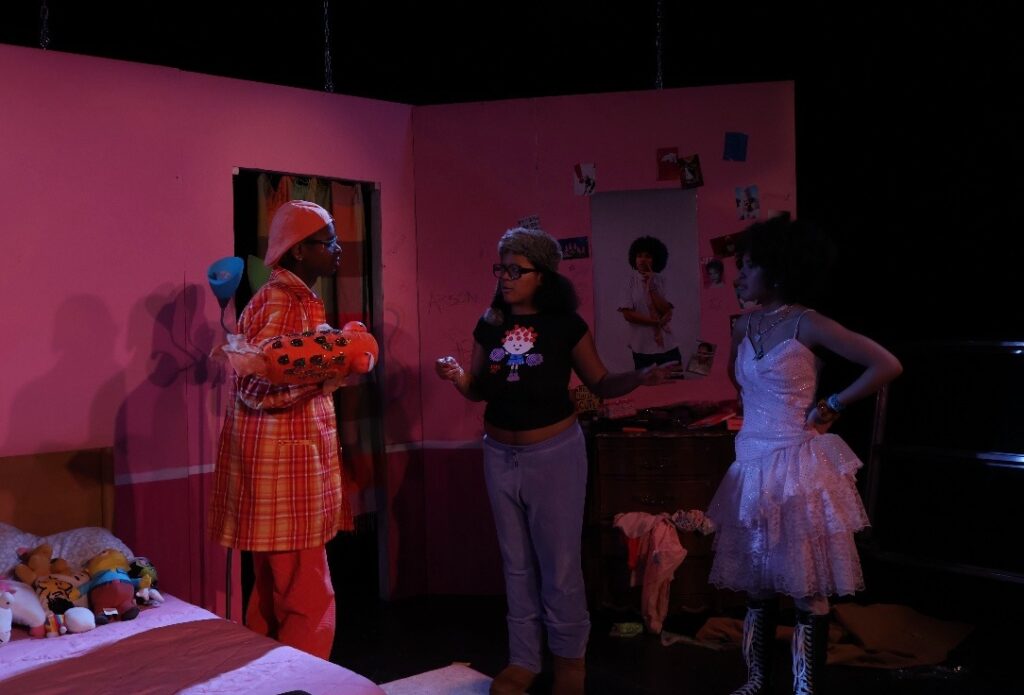
AD: Practically, you do something very bold and have Judas take a different form every night. Do you see that continuing for this production, or have you decided on a single one?
AML: There were just so many ideas I had in the process of making it where I just kind of laughed at myself and just went like, “Wouldn’t it be funny?” So, the first night we had a puppet. The second night, we just had a fish in a fish bowl with some saran wrap over it. And the last night, we just had them as humans. If I were to do it again, which I hope I could, I would maybe do something else entirely. In [my playwriting] class we always talked about having Judas in a huge fish bowl. That would be awesome to try.
AD: Any audience reactions that touched you, in particular?
AML: Andrew Clarke, my playwriting professor, came up and hugged me with tears in his eyes. And a lot of people being like, “You can really do this. Like, you can really take it elsewhere.” There were just really sweet reactions from people telling me, like, “This is the first time I’ve ever been seen on stage,” especially from my friends of color saying, “I’ve never felt so seen.’”
It’s been nice to see and finally feel for myself who’s also been through that to be, like, not only am I not alone in this, but, like, I’m giving people a voice to things that are just something. I’m happy you know what it’s like, too; and I’m happy that we can talk about it and laugh about it, but also be serious about it.
AD: In your playwright’s note, you mention that this play is hopefully relatable, but would you say that “Jamie Has A Bomb” is a fundamentally hopeful play?
AML: I think it’s hopeful. When a person of color writes or directs a play, there fundamentally has to be hope in it, because you need to have hope to survive. A friend of mine had said to me once, “We have to laugh, otherwise we’ll kill ourselves.”
To be a person of color in the world, even when there’s so many obstacles against you, you have to push through. You have to survive, which is different from most people’s experiences. There has to be an element of, like, “…but there is still tomorrow,” you know? That was what I wanted to achieve.
AD: Have you ever had an experience at the theater — Emerson or otherwise — that really resonated with you?
AML: I have two answers. At Emerson, Mercutio Troupe had put up a show called “Our Dear Dead Drug Lord” during my freshman year, and it completely rewired my mind. I’d never gone to a predominantly white school before; I was nervous, and I just didn’t know if I could find a love for theater like I used to have — until I had seen that show: seeing women of color on stage, not only being funny but dancing, fighting and being messy with each other. I learned so much.
And when I was 15, I saw [Jocelyn Bioh’s] “The African Mean Girls Play” at Speakeasy Stage. That was the first time I had seen an entirely Black woman cast; it was so much fun and such a visual meal, but I also learned so much about what it was like for African girls at this time, because it talked about skin bleaching and such. I got to meet the cast, and it was beautiful.
AD: What do you hope to see next for the independent art world?
AML: I hope more stories about Black women are pushed, especially now. A lot of shows and movies that are coming out right now are lacking a lot of Black women, and we need to highlight these stories because it is such a specific experience, and it’s such an unheard experience. I think we need to push for that more.
With independent art, I hope that it just gets people to pick up the pen, more than anything. Before I started this, I liked to write — I wouldn’t have considered myself a writer — but I think being able to watch good independent art made me feel like, “I think I have something to say, too. I don’t care who sees it, or how many people see it. I have something to say.”
I hate the word “industry.” I hate that word, unless we’re talking about the show. I know things look bleak right now, but I feel really hopeful about everything. Do you know how much power we have to just type some words into a computer, or to do a monologue, or to pick up a camera and film something just because? I just hope we take in the independent part of independent art and realize that we as artists have agency. We don’t need to be dependent on organizations or studios or anyone when we can just make what we can. People have done it before and we can do it, too. I hope that we realize we have so much more power than we think, and we have so many stories than can be told.
“Jamie Has A Bomb” is now available on YouTube. For updates on upcoming Emerson student theater productions from Mercutio, follow @mercutiotroupe on Instagram.
Regions: Boston