
Rendez-Vous With French Cinema – March 5-15
Unifrance serves up a delicious new edition of art cinema to Film at Lincoln Center patrons
Surprises galore pop up in the 22 features comprising the 31st Rendez-Vous’s partnership between Film at Lincoln Center and Unifrance.

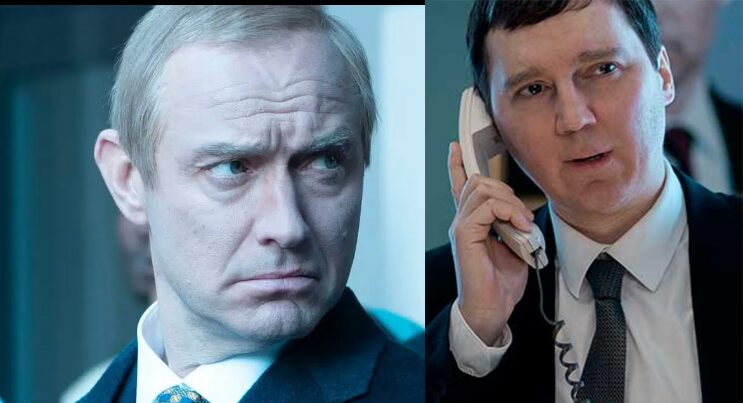
Why, there’s Charlotte Rampling, playing a stern classical musician and mentor in Two Pianos. Here’s Vincent Macaigne, France’s most tireless actor who can turn up in two and even three annual Rendez-Vous selections, only making a solitary appearance as Color of Time’s bee keeper. If Georges Simenon novels infallibly whet your appetite for a procedural, pounce on Inspector Mirgret and the Dead Lover. And could you even imagine Jude Law playing Vladimir Putin, with Paul Dano as his Wizard of the Kremlin sidekick? (Sorry, full local fest reviews on Oliver Assayas’s riveting drama of yet another strongman regime have been nixed.)
Another winter surprise unreeling in Rendez-Vous is not one but two strong lesbian dramas, in which the lead figures are Tunisian (In a Whisper) and Algerian (The Little Sister). Director Julia Ducournau continues seemingly impossible industrial strength body horror with Alpha, her Neon-fueled successor to Titane. And government insiders in DC eying an American Grande Arche sure to be built one day using white Carrara marble (what else, it’s so expensive) will pay close attention to The Great Arch, Stephane Demoustier’s fascinating take on a Danish architect’s broken heart. Finally, to sustain patrons through ten days and nights of Rendez-Vous’ surprises, right across the street from the Walter Reade theater is Cafe Paradiso, the only concession in New York City personally approved by Pacifiction director Albert Serra.
Here are your three Critic’s Choices, all of which will be shown in free FLC/ Unifrance screenings to NYC-area students.
The Stranger: François Ozon: 2025: France: 124 minutes

Camus’s book. Re-reading this slim 1942 novella, any cinephile is likely to pause, wondering why Michelangelo Antonioni never filmed it. Meursault, its narrator and protagonist, is the archetypal Antonioni wanderer: polite, intelligent, employed, amoral, a totally self-sufficient loner who is completely indifferent to everything and everyone in his life.
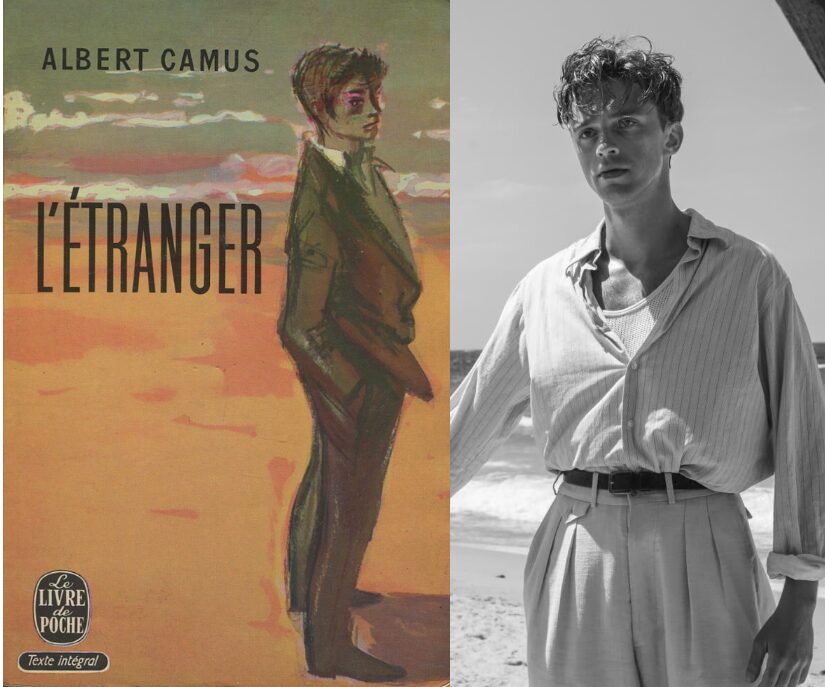
Camus wrote it while living in Nazi-occupied Paris, setting his tale of young Meursault burying his mother in an Algeria heavily locked in tradition. It was Camus’s first book and its first printing was just 5,000 copies, respecting wartime paper shortages. The Stranger’s first American publication was in 1947, under the title The Outsider, and the French paperback edition, L’Etranger, illustrating a young, sullen Maursault above, was in 1957, the year Camus received the Nobel Prize. Defining the misfortunes of alienated young adults ultimately paid off for Camus, who’d always hoped for fame and had no objection to L’Etranger’s original publisher changing “first printing” to later printings, hoping browsers would pick up the book and think it had sold a lot of copies. Maursault may have known he had no future, but Camus, like most authors, was always hoping for a better tomorrow.
Meursault is a smoker and drinker, if someone else is buying, Unable to support his mother, he’d moved her to a village nursing home, where she’d lived for five years until her passing. He dutifully takes a bus to her funeral, showing no emotion, a fact dutifully noted by every mourner. Back in Algiers, he ignores an elderly neighbor who beats his dog regularly and punches a clock as a bill filer. He takes his occasional lover, Marie, to Fernandel movies, a signal the book’s events are taking place in the late 1930s to early 40s. Marie’s a former typist at his office who picks up extra cash selling her body, while evaluating the handsome Meursault for possible marriage. They’re strong swimmers in the Bay of Algiers, and it will strike you that Maursault could have easily been played by a young Steve Cochran, Marcello Mastroianni, Jack Nicholson, John Malkovich or Mark Frechette, all Antonioni ‘anti-heroes’ and each an isolator.
The slender novella’s crisis point arrives after Maursault befriends Raymond, a local pimp with an Arab mistress. He asks the literate Maursault to write a threatening letter to the woman for him. Meursault indulges this request because Raymond’s furnishing food and wine. There’s a confrontation on the beach between Raymond and the woman’s brother, and Raymond entrusts Meursault with his gun. Later, Meursault, alone on the beach, is approached by the brother and a second Arab. One brandishes a knife and Meursault shoots him in self defense. Then he pumps four more bullets into the Arab’s body, killing him. Meursaldt is arrested, and spends eleven months in prison awaiting trial. He learns the penalty for premeditated murder is death. The prosecutor builds his case partly on sworn testimonies by villagers who witnessed Maursaldt showing no emotion at his mother’s passing. You can picture what Antonioni might have done with what’s come to be taught forever as Camus’s classic Drama of the Absurd.
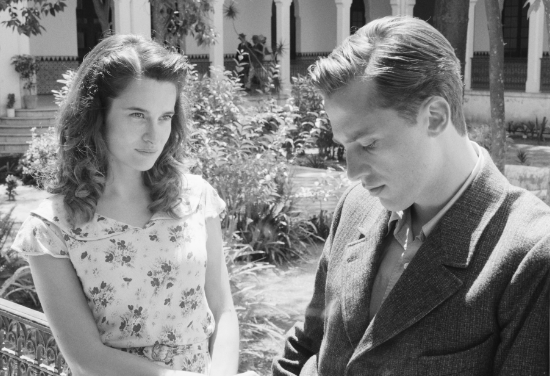
Ozon’s movie. Forget Antonioni, for the moment. Also put out of your thoughts Luchino Visconti’s 1967 color version of The Stranger, with a young Mastroianni, that Visconti actually filmed in Algiers. Ditto a 2001 Turkish version that’s conveniently reappeared online. François Ozon’s considerable accomplishment, which earns it Rendez-Vous’s Opening Night (and a firm placement in classics of world cinema), is faithfully executing the Camus text with seamless, 40s-style artistry. It’s shot entirely in black-and-white in 1.66/1 ratio (only slightly widescreen) by Manuel Dacosse. He films in a Tangiers propped to the teeth (old cars puttering through ancient locations) to look and feel like 40’s Algiers. The screen image often has a tired, faded grain in exteriors, like 40’s movies that haven’t been boosted up with 2K restorations. The look is impeccable.
Ozon’s adaptation with Philippe Palazzo does tweak in a few flourishes that make Maursaldt (Benjamin Voisin, commendably stoic) appear even more immersed in his own ennui. His mother now has a frail, aged nursing home fiance who barely limps through desert heat to his love’s burial, while Meursaldt saunters wordlessly ahead. Marie (Rebecca Marder, shrewdly combining her roles as seductress and innocent) is no longer selling her body for money. The 1938 Fernandel movie Marie and Meursaldt attend, Le Schpountz, actually has the big-toothed comic gleefully voicing France’s ultimate punishment for wrongdoers – the guillotine. And in the kill scene, the lone Arab now pulls a knife while reclining in the sand, while Meursaldt, blinded by the sun, takes a step toward him, firing the first of five bullets into him. Ozon carefully removes most ambiguities latent in Camus’s novella.
And then Ozon does something much bolder: He conjures what might have occurred after the court verdict has been rendered, had Camus continued Meursaldt’s journey. This is where thoughts of Antonioni – not to mention Ingmar Bergman – may start running through your consciousness, as they tug at your conscience. A half dozen added scenes, some dreamed, some played in real time, suggest new aspects of Meursaldt’s soulless existence as well as his country’s crushing colonization of its Arab community. They’re yours to discover and weigh.
Ozon needn’t be concerned that France will embrace a native son’s version of its third best selling novel of all time, after Les Misérables and The Little Prince. Ozon fully honors Camus’s Nobel Prize in literature… then unveils his own artistic interpretations as a bonus for France’s citizens (and the world’s cinephiles) to endlessly agree, disagree or debate. It’s a win-win for the filmmaker, the author, and the viewer.
Case 137: Dominik Moll: 2025: France: 115 minutes
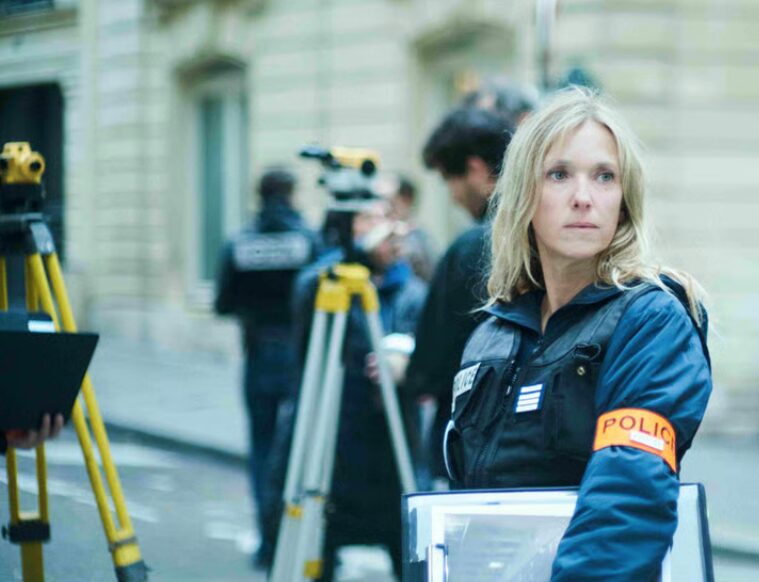
Case 137 is a composite story, real and imagined, drawn from the 2018 “Yellow Vest” Paris protests along the Champs-Élysées. You could sigh that it’s the best or worst of times for such a movie. The confrontations between citizens and authorities along Paris’s high end avenue, culled and updated by Dominik Moll, are tense and vivid. They show a mix of protestors – some hard-right anarchists bent on trashing storefronts and hurling projectiles, others rural teens, visiting Paris for the first time from a tiny town. Like so many protests that dissolve into anarchy, everyone here is caught in the sudden chaos of overwhelming police response – bulldozers, tear gas, water cannons, metal barricades, bone-crushing batons.
One teen, Guillaume (Come Peronnet), has been shot in the head with a riot gun, suffering a skull fracture and permanent brain damage. The boy’s companion Remi (Valentin Campagne) captures his unconscious classmate on his phone, being carried into an ambulance. Remi will later claim an officer not only shot his friend but kicked his body over in the street before exiting with the other police.
The task of investigating this brutal incident falls to Stephanie – Lea Drucker, one of France’s most versatile (Auction) and accomplished (Custody) actresses, cast as an internal affairs inspector in the “police’s police” division. She’s a divorced single mom with long duty in narcotics alongside her former husband (Stanislas Merhar). Her new job as an administrative inspector is a big step up in responsibility. She’s thrust into the exceedingly sensitive and unenviable position of not just ferreting out footage of the students and their pursuers, but pulling together all the bitter accusations, impassioned defenses, outright lies and ugly truths often embedded in protest clashes.
We sense right away Stephanie’s a good cop who’ll give her all to discover the truth. Moll’s script hands her bonuses like a cute kitten she’s rescued, plus some real skin-in-the-game hailing from the same small town as Guillaume and his mom. As it happens, the victim’s mom and the police inspector’s mom know each other.

Case 137 quickly settles into a streamlined and urgent procedural, with Stephanie and an associate (Mathilde Roehrich) poring through camera videos from every street corner light pole. They’re able to isolate the teens and the particular plainclothes cops, but not their fateful encounter. She brings in and questions each of the five officers. All deny involvement with the wounded teen, so Stephanie revisits the crime scene and studies footage of the surrounding buildings in twilight. In the image of a luxury hotel, she spots one lit room and a shadowed form in that window. The hotel manager is able to pin down that the room was empty of guests and the shadow may have been the maid hired to clean and turn down the room for its next occupant. The maid is Alicia, and she’s played by the always compelling Guslagie Malanda (critic’s choices, My Friend Victoria and Saint Omer). This is where you sit up straight, as case 137 and its movie enter thrillingly uncharted territory.
The tipping point running though all two hours of Case 137 is whether justice can ever be served when an in-house division is in charge of cleaning its own house. Moll is a meticulous writer/planner/shooter/editor and you sense everyone in a large ensemble cast bending to the task. The marvel of Drucker and Malanda’s charged scenes together is that you can read their aching vulnerability even when neither woman’s face or voice is showing uncertainty. The director surely senses this when he has Stephanie phoning her son, stuck at home with a cold supper, as she’s crouched in a subway train, tailing Alicia who may be more than a casual connection to the case. And then there’s Stephanie’s kitten. And that very human connection between the two moms. Dominik Moll, like François Ozon, respects the intelligence of the audience he hopes will Rendez-Vous with their movies. They are filmmakers who, like Assayas, earn our trust, which today at the movies is no small accomplishment.
Colors of Time: Cedric Klapisch: 2025: France, Belgium: 124 minutes
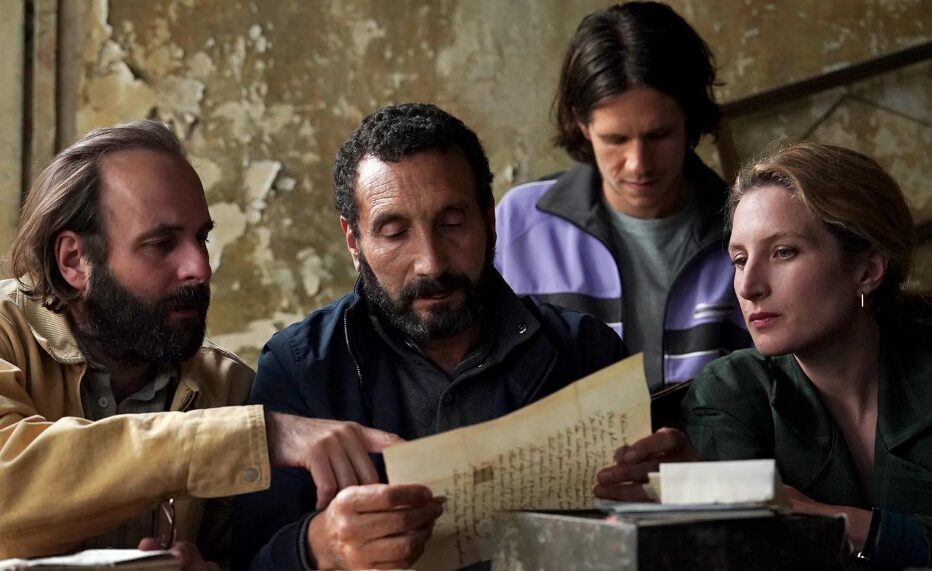
For this writer, “Rendez-Vous,” as in this fest’s title, has always suggested a secret tryst. Magic and mystery, which the French stir to perfection. If you’ve ever poured through photos of your own family relatives in Polaroids, Kodachrome snaps, or cardboard daguerrotypes, guessing what sort of lives they once lived, Cedric Klapisch’s gloriously buoyant ode to one family’s painters and photographers is your movie.
A genealogist in Paris has gathered together several dozen descendents of a Frenchwoman who lived in a Normandy country home in the 1880s. The city wants to buy the property and home, abandoned since the 1940s, and erect a shopping mall. Four family cousins, representing a cross-section of modern Parisian life, are chosen to open the home and inventory anything remaining. They include Celine (Julia Piaton), an overworked industrial engineer; Seb (Abraham Wapler), a cynical fashion photographer; Guy (Vincent Macaigne), a back-to-nature beekeeper; and Abdel (Zinedine Soualem), a middle school teacher about to retire. Entering the all but emptied ruins of the farmhouse, they discover walls and closets of dusty photos and drawings left behind by whoever lived there, There’s a tintype of a striking young woman and –
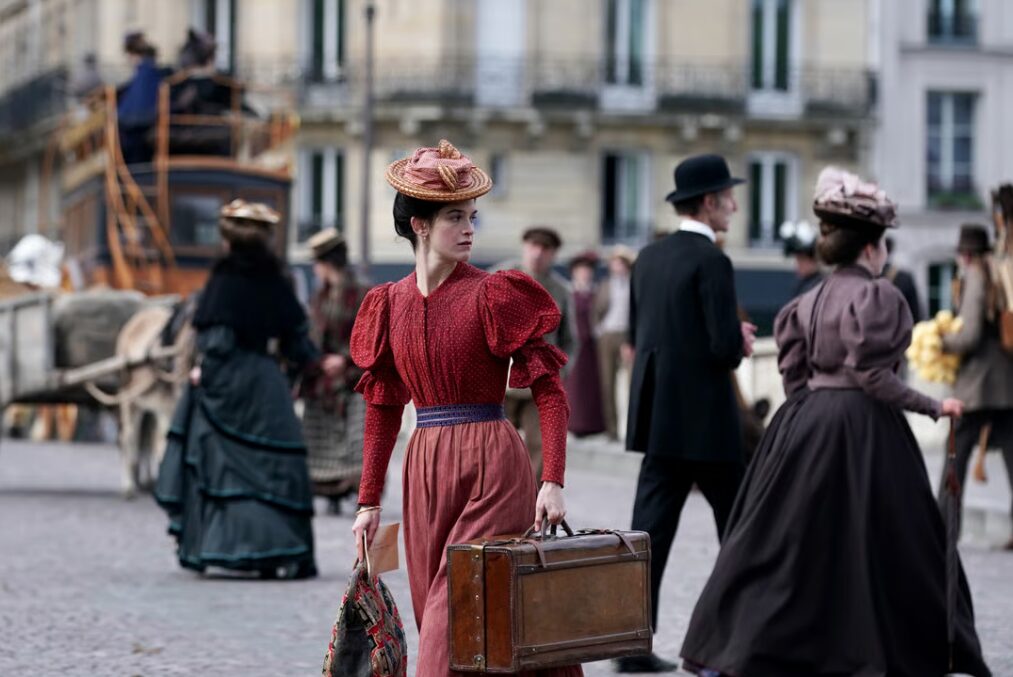
Blink! Director Klaplisch cuts back to 1895, when 21-year-old Adele (Suzanne Lindon, fresh as spring) packs that photo into a suitcase and leaves her farm home and neighboring beau, bound for Paris by hay wagon and steamboat. Adele simply wants to find her mother, who disappeared from her life in infancy. Klaplisch is starting us on a journey of contrasts – how the French lived a century ago verses how the French live today, in a world of urban renewal, internet chat rooms, and fashion shoots where if someone doesn’t like how a garment color looks against a classic background painting, it’s easy to change the color of the painting.
Klaplisch isn’t a hermit or Luddite, and he’s not devastated or enraged by 2026 tech. In Colors of Time he’s amused, bewildered and sometimes saddened. He’d rather be in an uncrowded, slow lane, turn-of-the-century Paris poised on “the coming of the future” (his original title of this movie), when the City Of Lights hadn’t quite yet invented electric lighting. He’s betting you will be, too. And so that’s what he creates with an arsenal of master skills, drawing upon superb production design, authentic costuming, breathtaking back-and-forth editing, light touches of CGI, and even old-fashioned matte paintings, plus a deft music score that’s tickling and whimsical every minute it soothes you along.
Adele is befriended on the boat by a convivial young painter, Aratole (Paul Kircher) and photographer pal, Lucien (Vassili Schneider) who are also seeing Paris for the first time. Working on a tip from a family barrister, Adele finds her mother, Odette (Sara Griraudeau), independent and fiercely proud, employed in an ornate and top-of-the-line bordello. Mother and daughter bond, and Odette reveals that her daughter’s father was one of her two lovers, either an up-and-coming painter of the era, or an up-and-coming photographer of the era.
It doesn’t give away too much of Klapisch and co-scripter Santiago Amigorena’s endlessly creative plot to confide that the photographer is Felix Nadar and the painter is Claude Monet, both of whom Adele will meet. And that, in the spirit of every topnotch acting troupe’s credo, “let’s-put-on-a-show-that’ll-knock-em-dead,” Klapisch inserts a scene in which the four modern-day cousins get stoned and break the fourth wall, entering and mingling with a gallery of legendary French artisans. Klapisch gets away with this, too, as well as half a dozen other sophisticated conceits that are scarcer than hen’s teeth to find in most international art cinema features. (Especially watch Wapler, who briefly turns up in a dual role.) Colors of Time is packed to the rafters with feel-good surprises. It’s the movie-movie of this Rendez-Vous.
This concludes critic’s choices. Watch for Brokaw’s picks in New Directors/New Films, co-sponsored by Film at Lincoln Center and The Museum of Modern Art, April 8-19.
Regions: New York