
Patrick Page brings actor’s charm but writer’s naivete in ‘All the Devils Are Here’
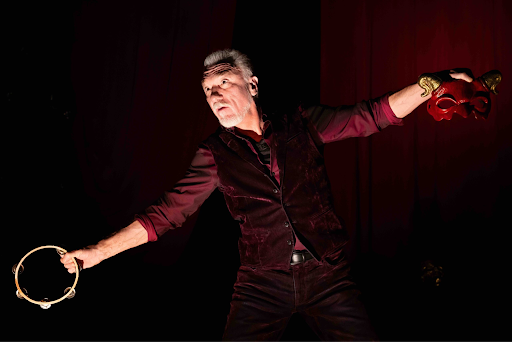
“All the Devils are Here: How Shakespeare Invented the Villain”, a one-man “play” written and performed by Tony-nominated theater legend Patrick Page sounds like an advanced seminar. If tempted to buy a ticket, beware: a 90 minute lecture is precisely what you’ll get.
In the play, Page plays himself as a witty narrator, guiding the audience through a chronological examination of William Shakespeare’s work — specifically his portrayal of evil. He demonstrates how Shakespeare’s thinking about evil evolved throughout the playwrights life, from early shallow caricatures of sin inspired by morality plays to later characters with complex psychologies and backstories.
The lecture is punctuated with acted-out scenes of Shakespeare’s villains. Page summons some of the playwright’s most notorious characters, including Richard III (“Richard III”), Aaron the Moor (“Titus Andronicus”), Claudius (“Hamlet”), Prospero (“The Tempest”) and Macbeth and Lady Macbeth (“Macbeth”).
The thesis Page sets out to prove, as he states at the top of the show, is that “Shakespeare invented the villain.” The claim is bold, and faulty to an extent. Shakespeare undoubtedly expanded the repertoire of complex antagonists, but he did not invent the three-dimensional villain. Complex psychologies in flawed characters were long present in classical literature and across cultures (see Medea from ancient Greece or Gilgamesh from ancient Mesopotamia).
The engaging moments of intimacy audiences get to share with Page due to his self-depiction are effective — the seminar-style less so. Page’s starry-eyed love for Shakespeare bleeds into his writing, preventing it from offering a thought provoking study of the playwright’s own flaws and complexities. At a talkback after the show, Page confessed that Shakespeare has been his passion since college, when he would create one-man shows “just out of the need to act.”
“I really feel that [Shakespeare], in a way, knew more about human beings than virtually anyone who’s ever lived,” Page said.
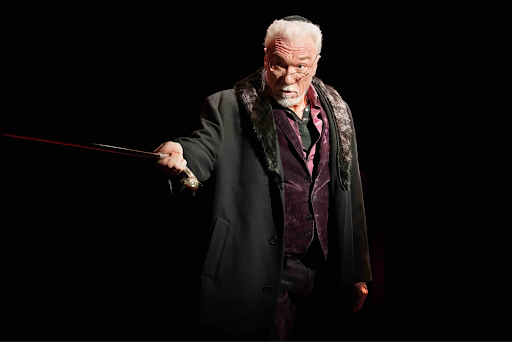
Where Page lacks depth as a writer, he wields immense power in his acting. Dubbed the “Villain of Broadway” by Playbill for his many portrayals of dark characters (such as the titular Hades in Hadestown), he naturally switches between distinct characters with ease, no matter their gender and cultural background. His famous basso profondo voice, the deepest of all male voice types, builds much of the suspense on its own. Paired with Page’s unique voice type, the simple blood red backdrop and frequent lighting changes vary the scenes and create moments of genuine terror.
Page’s venture into scenes, though demonstrative of his point, often drag on for too long, proving that Shakespeare’s scenes should not be separated from the context of their world. Ripped from it, they lose their stakes. That’s why the most interesting moments occur when Page seamlessly switches from one character to the next, a reminder that you are watching a seasoned professional at the top of his craft.
To an extent, the play reads like one big audition for Page to play these parts, which is likely enough to draw in audiences. At the opening night performance at Emerson College’s Robert J. Orchard Stage in Boston, attendees brought a rich prior love for Page to the evening.
The audience took many of Page’s rhetorical questions literally. At the prompt “do you believe in evil?” many shouted out an enthusiastic “yes!” They continued to “ouu” and “ahh” in adoration until the end. The audience and Page were undeniably charmed by one another, creating an engaging dynamic between the actor and his audience.
If nothing else, Page’s deep fascination with and knowledge of Shakespeare’s oeuvre is admirable, and he is confident, if not entirely convincing, in his thesis. The title itself references the character Ferdinand in “The Tempest: “Hell is empty/And all the devils are here.” In the play’s most effective moment, near the end, Page invokes the line as he confesses that he sees parts of himself reflected in all of these characters. Dark qualities, he suggests, are not some irredeemable external force but rather something that lives inside all of us.
Much like a professor who believes his area of study is the most compelling of all, Page manages to make the dissertation only sporadically engaging and, unfortunately, minimally boundary-pushing. In the end being witness to Page’s craft becomes the entertainment value, not his writing. As he takes the show on the road, whether the material will land with audiences who aren’t already Page or Shakespeare devotees remains to be seen.
“All the Devils are Here: How Shakespeare Invented the Villain” will play at the Geva Theatre in Rochester, NY next. Find ticket information and additional shows here.
Regions: Boston