
In ‘Peter Hujar’s Day,’ That’s the Way It Happened
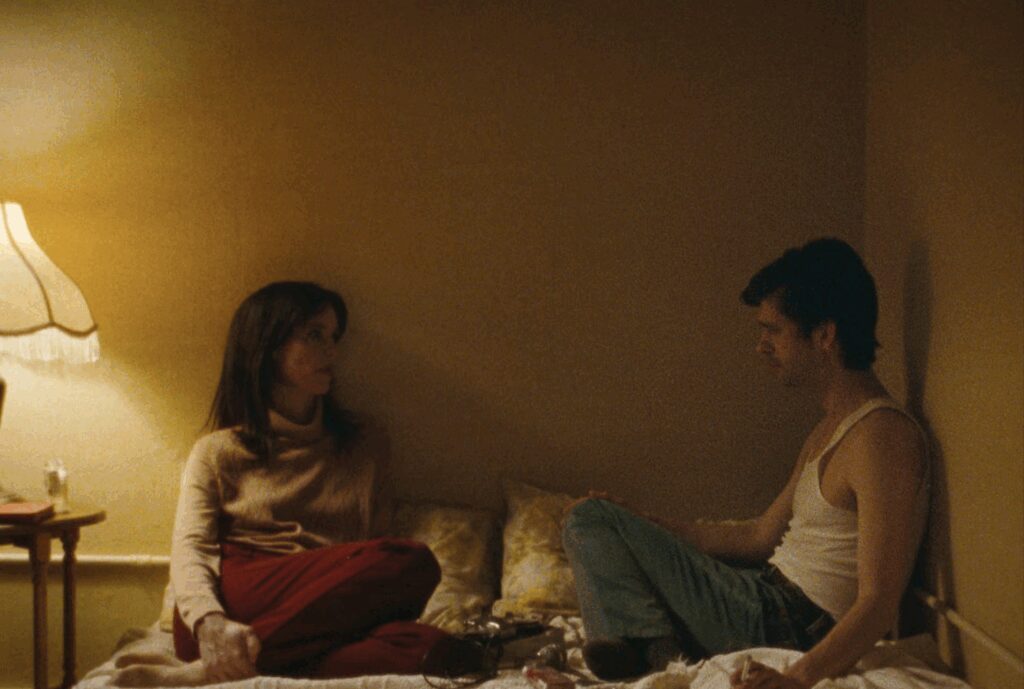
“Peter Hujar’s Day” tells the unconventional true story of a day in the life of the photographer Peter Hujar, as told to his friend, the writer Linda Rosenkrantz, in 1974 New York City.
One friend interviews another on a tape recorder; as far as the plot goes, that’s it. Aside from some on-screen text at the beginning of the film, just one hour and sixteen minutes later, little else has happened. Despite a few formal tricks, the film adheres strictly to a single location and just two actors. If this sounds boring to you, you’re not alone — Peter Hujar thought so too.
But it’s a good thing that Linda Rosenkrantz didn’t. Her book, “Peter Hujar’s Day,” began as just one piece of a larger project. In 1974, the Bronx based writer set out to interview several of her artist friends about what they did on a given day. She would ask them to note each detail of their day, to be recalled later in a taped interview.
One of the first to participate was the photographer Peter Hujar. Hujar reportedly made his notes in a hasty 12 minutes, having forgotten he was meant to recall the events of that day — December 18, 1974 — for his interview with Rosenkrantz, after breezing through the previous 24 hours without the requisite self-awareness. Although Rosenkrantz eventually abandoned the project, their conversation survived. “Peter Hujar’s Day” — a volume as slim and unassuming as the film that bears its name, its spine merely reading “18 DEC 1974” — was published in 2019.
Written for the screen and directed by Ira Sachs, the film stars Ben Wishaw as Hujar and Rebecca Hall as Rosenkrantz. It unfolds as something of a continuous monologue for Hujar, who lounges, drinks, and chain-smokes, while being occasionally interrupted by editorial remarks or clarifying questions from an otherwise silent and keen eyed Rosenkrantz.
Much of the dialogue is ripped verbatim from Rosenkrantz’s transcript, in which Hujar laments and opines many of the subjects that are just as commonplace to any artist’s life now as they were 50 years ago. These include topics such as: who is reviewing his gallery show, how much money is owed to him for the portraits he took, whom he might sleep with and when he has the time to do so.
In adapting such an unconventional text, Sachs sets out to affect a kind of uber-theatricality: a film with striking awareness of its self-imposed constraints that nevertheless boldly declares itself worthy of being represented. It becomes, then, not unlike the work of someone like Hujar, who carved out a place for himself as a gay man in a world that was otherwise hostile toward him, and was also an integral part of a generation of queer New York artists who broke barriers of self-representation in the 1970s and 1980s.
In that minute mode — its rooftop shots of the New York City skyline as well as frank discussions of neighborhood dynamics and populace — the film becomes a kind of tribute to an old New York City, one that teemed with gay life in a flourishing pre-AIDS bohemia. And sadly, Hujar, like far too many of his queer contemporaries, died of AIDS-related complications in 1987 at the age of 53.
In recapturing and reinterpreting Rosenkrantz’s project so carefully and with such fidelity to its language, Sachs stages a version of the present devoted to recapturing, recreating and preserving the past. He dramatizes the ordinary while attempting, against convention, to preserve mundanity in all its wrinkles, gaffs and plainness.
To say that the film breaks the fourth wall would be something of an understatement. After on-screen text informs the audience of Rosenkrantz’s project, the film opens on the slate itself. We are ostensibly catching Ben Wishaw between takes before the action of the first scene even begins; it’s often difficult to tell if he’s in character yet. During several scenes in the film, the action simply stops, classical music begins to play, and we are presented with a tableau of Rosenkrantz and Hujar — or perhaps Hall and Wishaw — posed somewhere on set. It’s a deft way of collapsing the space between actor and character, book and film, past and present.
Within adapting Rosenkrantz’s project, Sachs amplifies its most strikingly contemporary ingredient: the performance of authenticity. Wishaw is performing, Hujar was performing; Hall is performing, Rosenkrantz was performing. Performing for the tape, the book, the director, the camera, themselves, us. Hujar is constantly wondering if he has done enough in his day to make what he is saying interesting. This, in turn, leads him to wonder with increasing frustration if he can really be shrewd enough to distinguish his good portraits from his mediocre ones, and if he is rigorous and talented enough to produce good, consistent work.
Hujar admits to Rosenkrantz that he has lied to several characters in his story, and when she catches an inconsistency early on in the interview, he admits: “Oh, I guess I just lied.” They smirk at one another — this comes with the territory. It’s a clever bit of table-setting on Hujar’s part, and a convenient one for Sachs, who announces upfront that this is a film of contradictions. Nothing is sacred, everything is on purpose, everything is by accident, and nothing can ever be telegraphed exactly as it occurred. It’s Hall and Wishaw, not Hujar and Rosencrantz who we are watching, and rather than attempting to close the gap between the two, Sachs locates the dramatic center of the film in the contradiction between the story of the day and the story of its telling. Operating beautifully from that in-between space, Sachs plays the rhythms of their conversation to shape Hujar and Rosencrantz’s friendship into a singular work of art.
Peter Hujar’s Day is now streaming on the Criterion Channel.
Regions: Boston