
Don’t Watch Yourself, Watch the Movie: ‘Teenage Sex and Death at Camp Miasma’
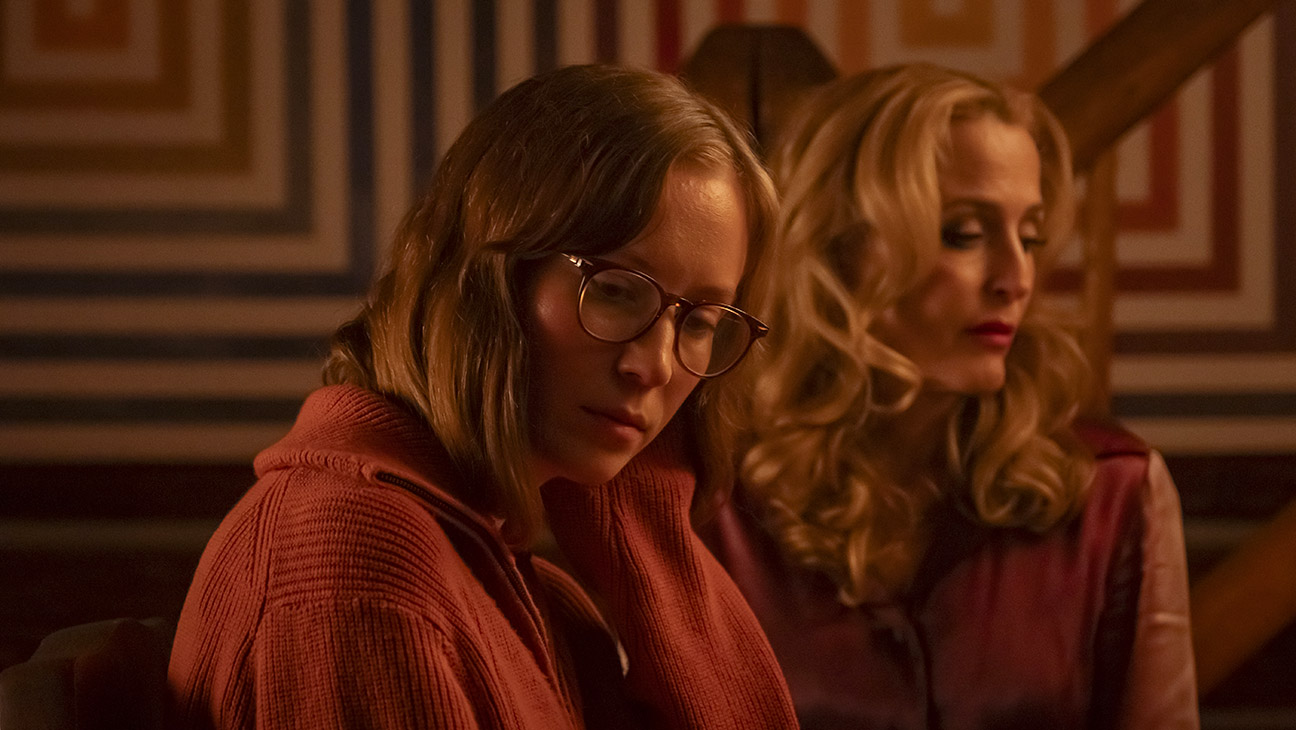
Jane Schoenbrun isn’t one for subtlety. Although their sophomore breakthrough “I Saw The TV Glow” was derided by some for being too forward in its messaging (all trans allegory with no room for interpretation), their new feature “Teenage Sex and Death at Camp Miasma,” which premiered in Un Certain Regard at this year’s Cannes Film Festival, puts to bed any suspicion that their brazenness is akin to a sloppy hand; the psychosexual chamber piece deploys a flurry of self-reflexive flourishes with gleeful intentionality.
For as long as she can remember, indie filmmaker Kris (Hannah Einbinder) idolized the image of Billie Presley (Gillian Anderson), the actress immortalized as the final girl in the cult-classic 1980s slasher film “Camp Miasma.” She even has a fondness for the cash grab sequels and tie-in products the film inevitably spawned. Off the success of her first feature, an indie horror Sundance darling, Kris jumps at the chance to pitch a fresh new take on the “Camp Miasma” franchise.
Her first move is to locate the reclusive Billie and coax her out of retirement. From their first meeting, Kris is an audience for Billie, representative of, and interchangeable from, her “Camp Miasma” character. As their initial meeting stretches into the night and the next day, sequestered at Billie’s remote cabin, the lines between negotiation and seduction begin to blur.
In Kris’ obsession with the “Miasma” franchise and entanglement with Billie, Shoenbrun asks us to consider our own relationship to cult objects, the ways in which we worship our own Billie Presleys and conflate them with the effect their character had on our impressionable young minds. Each of us, in some way or another, has been just where a young Kris is in one scene — sat much too close to the television, transfixed and irrevocably altered by something we were far too young to be watching. That image was the thematic anchor of “I Saw the TV Glow.” In “Teenage Sex and Death,” Shoenbrun asks what happens when that kid grows up; it turns out they might want to get fucked by the slasher villain.
In the case of the film-within-a-film that is “Camp Miasma,” that slasher villain would be Little Death (a nod to the direct translation for the French “la petite mort,” a colloquial term for orgasm), who recalls Jason Vorhees and Michael Meyers but alchemizes into something truly original. A one-time Camp Miasma camper whose gender fluidity led to alienation and made them the victim of a lethal hate crime, they are subsequently reduced to a ghost story (in which they rise from the dead for revenge) used by unfeeling councilors to scare new campers. Beautifully designed by costume designer Kendra Terpenning, the killer sports a white plastic bodysuit and an enormous helmet resembling an HVAC vent, their eyes peering out of the center, wielding a phallic metal spear as their weapon of choice.
Jack Haven, whose key supporting role in “I Saw the TV Glow” saw them taking a cypher of a character and imbuing them with raw humanity, gives a similarly fearless performance as Little Death, nearly wordless and at times acting only with their eyes.
In one particularly stunning sequence, a killing spree shot mostly from Little Death’s point of view, their head is covered by their blood-splattered helmet. For a moment, they fall to their knees and wipe the blood off to reveal their eyes. Haven takes this beat to telegraph a tornado of emotion: loneliness, despair, desire, confusion. It is an electrifying performance, elevating a character who is introduced as an urban legend, less than human, into someone tangible and tragic.
Much of the film operates as a two-hander between Billie and Kris, with the two virtually stranded at Billie’s home — the very campsite that served as the shooting location for “Camp Miasma.” The set is winkingly artificial, the production design by Brandon Tonner-Connolly employing beautiful matte paintings that Shoenbrun and cinematographer Eric Yue make no effort to pass off as practical vistas. As a result, the campsite takes on a kind of eerie effect; it’s more of a feeling than a place, the kind of feeling Kris is desperate to capture in her remake. Her pursuit of this provides the engine for the film’s strikingly ambitious third act, where Shoenbrun does away entirely with the line between film and reality.
Einbinder, most known for her Emmy-award winning turn on the television comedy “Hacks,” is as able here to deliver wry Gen-Z asides (this is the first film, as far as I’m aware, to have a character utter the phrase “because of woke”) as she is to extricate the knottier psychosexual issues plaguing her character. The fact that she is asked to open up emotionally only as the film becomes more heightened and surreal, managing still to maintain a sense of vulnerability, is a testament to her previously underutilized agility as a performer.
Anderson is a winning bit of casting given her status as a sapphic sex symbol to Gen Z and Millennials alike. It helps that she is such a tenacious performer, in complete physical control even in moments when her hold on reality is called into question. Billie lives something of a regressed life, surrounded by “Camp Miasma” memorabilia, living off of candy and fast food with no internet access. Anderson shrouds Billie in mystery, giving her a heightened affect that, as Kris peels the layers away, tragically begins to resemble self-defense. It’s a thorny, cheekily alluring performance.
With this pair, Shoenbrun makes the shrewd choice to eschew a slow-burn, using their simmering sexual tension as a bridge to entertain the moviegoing experience as akin to kink. Their courtship is refracted through the act of rampant consumption of junk food and jumpscares. Here, Jolly Rancher gummies are a potent aphrodisiac; the sound of a blood-curdling scream veritably pornographic. Their respective relationships to “Camp Miasma,” however disparate, become symbiotic. For all its references to “Sunset Boulevard” (there are several), Kris and Billie do quickly begin to resemble a queered Norma Desmond and Joe Gillies.
There are a handful of memorable supporting roles that round out the cast: stalwart character actors Dylan Baker and Patrick Fischler each make brief appearances; “Sorry, Baby” filmmaker and star Eva Victor sports a mohawk as punk camp councilor DJ Ella Giastic, making a meal out of repeated use of the pejorative “freakhouse”; Amanda Fix, as a young Billie, performs in a style similar to Haven, as we read everything in her eyes to equally devastating, gripping effect.
“Teenage Sex and Death at Camp Miasma” is the kind of ambitious swing for the fences one hopes to see from an independent filmmaker, so clearly bursting with big ideas and not trying to please any audience beyond the one it knows is waiting for it with open arms. Though one does wonder if there are other veins Schoenbrun is looking to mine — these ideas, though potent, do start to feel familiar three features in — it’s hard to complain when they can conjure up scenes that are at once blithely comic, romantic and achingly terrifying.
“Teenage Sex and Death at Camp Miasma” had its world premiere at the Cannes Film Festival on May 13. It is slated for theatrical release on August 7 from Mubi.
Regions: Cannes