
‘Blind Love’: Can We See Beyond Heterosexuality in the East Asian Family?
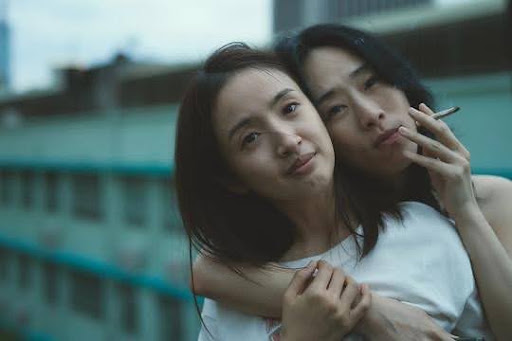
Men, women, rooms, glass. These are the constituent elements of “Blind Love.” In this film, characters are constantly placed within structures: architectural boundaries extend through bodies, and relations of familial and class power circulate within them.
Directed by Julian Chou, the story follows Shuyi (Ariel Lin), who maintains a respectable family life with her surgeon husband (Frederick Lee) while suppressing her desire for autonomy over her own life and body.The reappearance of her former lover, Xuejin (Ke-Xi Wu), rekindles feelings she has never fully let go of. Meanwhile, her eldest son, Tianhan (Jimmy Liu), who is struggling against his father’s plans, meets Xuejin by chance and becomes attracted to her. The mother and son’s entanglement with the same woman gradually exposes the secrets and fractures beneath the family’s respectable facade, forcing them to confront desire, identity, and familial obligations.

Set against the background of Taiwan’s 2015 marriage equality movement, the film examines the constraints women in same-sex relationships faced before legal recognition in Taiwan. But although it brings same-sex desire into the narrative, it does not sufficiently grant this relationship a position of subjecthood independent of the traditional family. Instead, beneath its queer exterior, the film reproduces the patriarchal structures of traditional heterosexual relationships.
“Blind Love” is not solely a queer film, but also a discussion of gender through familial and class power. Through this organization of relationships, audiences can see the structural homology of power among ruler and subject, father and son and husband and wife in traditional Chinese language culture ethics.
Love is often used as a metaphor for loyalty, and transgressing the boundaries of power has always been more taboo than same-sex affection itself. In “Blind Love,” Li Yifeng’s profession as a doctor and his family life reveal interconnected structures of power. Seeking promotion and the approval of the hospital’s board, he treats his wife’s decorum and his sons’ academic achievements as evidence of his own social standing, requiring his family to maintain this respectable image. At work, he must meet the expectations of those above him; at home, his economic position makes him an authority who demands obedience from others. The two relationships thus mirror each other, while within the marriage, loyalty expressed through obedience is treated as proof of love.
His wife, Xu Shuyi, who was born into poverty, bears the responsibility of sustaining this patriarchal order stemming from Yifeng’s authority. At home, she must ensure that their two sons’ academic performance and everyday conduct meet her husband’s expectations. Outside the home, she must maintain her relationship with Mrs. Gu (Mingming Su), the wife of a hospital board member, to help Yifeng secure a place on the board. Her domestic and social labour serves her husband’s status, while her personal freedom is subordinated to these responsibilities. His authority is continually reinforced in the process. Thus, the husband becomes the villa itself. As she lives protected beneath its structured roof beams, she is simultaneously enclosed by the house, ultimately unable to escape easily.
Around Xu Shuyi and Li Yifeng, the film establishes two opposing sets of relationships. One set of relationships centres on Shuyi: her romance with Xuejin, her relationship with her mother and her bonds with her two sons. The other consists of Yifeng’s relationships with the hospital, the upper class, and the resources he commands. Within this opposition, we quickly discover that Li Yifeng’s existence is functionalized. Throughout most of the film, the “father” lacks complexity beyond his position of authority and is instead placed alongside the hospital, class, and assets. At the same time, this opposition is unstable, since the expectations of Shuyi’s mother shape Shuyi’s self-repression, and Shuyi passes the same demands for respectability on to her sons. Power therefore comes not only from the husband, but is also perpetuated through love, care and the expectations of family members.
Here, the structure of the house extends outward from the husband’s body, while the other characters become shadows of its framework. Xu Shuyi’s two sons sustain this framework to different degrees. The elder son, Li Tianhan, has an Oedipal quality to his rebellion. As he attempts to escape the life his father arranged for him, he falls in love with his mother’s ex-girlfriend, Luo Xuejin (Ke-Xi Wu), and competes with his mother over their shared object of desire.
Although Li Tianhan ultimately resists familial and class discipline alongside his mother, he still repeatedly interrogates his mother over whether she perfectly embodies the East Asian “Yamato Nadeshiko;” the ideal of restraint and self-sacrifice. Li Tianhan’s rebellion is contradictory, because his rejection of his father’s arrangements doesn’t mean that he has already acknowledged his mother’s right to an emotional life that doesn’t revolve around him. Therefore, the father, as a symbol of patriarchal authority, thus functions like the house’s supporting beams, confining Shuyi within its framework while turning the male family members into the building materials that sustain it.
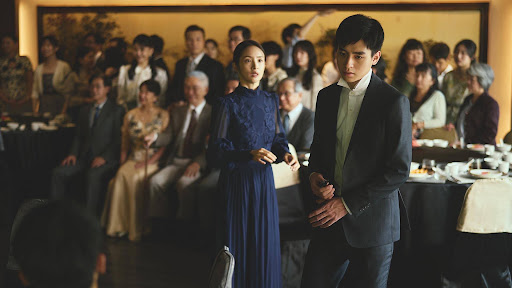
The younger son, Li Tianrui (Brooklyn Hsu), embodies another contradiction: he both resists and accommodates patriarchal authority. Through his repeated questions about his father’s use of a mobile phone, the film makes the child a questioner of adult life. However, when a video of his mother kissing her ex-girlfriend enters his father’s field of vision, Li Tianrui’s looking inadvertently becomes surveillance on behalf of symbolic patriarchal authority. In this, Li Tianrui is an unconscious vehicle for reinforcing his father’s power.
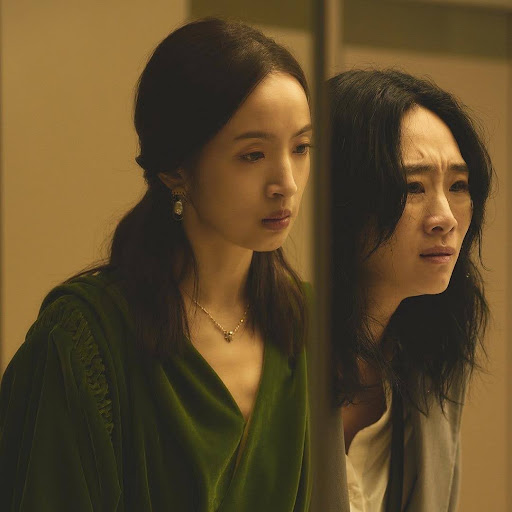
The reappearance of Luo Xuejin seems to offer Shuyi a possibility of escaping the patriarchal framework of her life. Contrary to the villa, which symbolizes family assets and social respectability, Xuejin’s apartment is naked, just like Xuejin herself; the rooms are filled with nude photographs, while glass continually exposes the space to the outside. As Shuyi, Tianhan, and other characters enter it in succession, they make choices that contradict the expectations attached to their existing identities. Chou deliberately positions the body and sexual discourse as a path toward the liberation of the female subject, attempting to resist construction of Shuyi’s reserved and respectably dressed image.
However, the openness of the space does not automatically bring about the unfolding of Xuejin’s queerness. It actually overlooks Xuejin’s own identity, turning her existence into a performance and a mechanism for responding to the actions of all the other characters. In her relationship with Shuyi, we see a clear active–passive relationship. The emotional relationship between the two women is a replication and reaffirmation of the heterosexual power relations in reality. Xuejin is “made up” as a man, with Wu Kexi’s performance presenting the active partner’s masculinity in a stereotyped manner. Yet, in front of Tianhan, she becomes an object of desire endowed with the allure of a mature woman. Her initiative always serves Shuyi’s awakening, and her allure always serves Tianhan’s growth; thus, this seemingly free existence is actually constrained by its function.
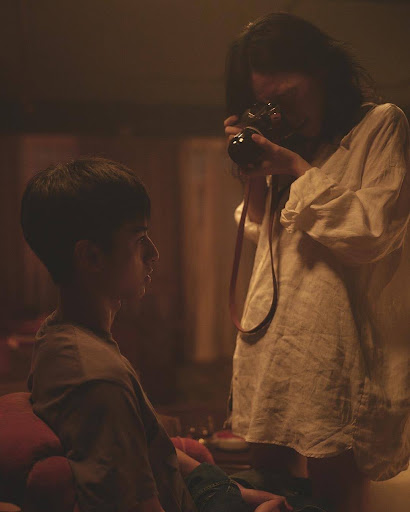
Just like Yifeng, everything about Xuejin is functionalized. Xuejin is assigned a liberating function, while Yifeng is assigned an oppressive one, the two of which form narrative symmetry. The power relations, conventions and rules between the sexes are repeatedly invoked within a same-sex relationship. Xuejin’s subjecthood disappears behind her identity as a photographer. As a pair of gazing eyes, “she” watches the visual pleasure produced by Shuyi’s predicament without putting any corresponding mechanism of response into action. Instead, Xuejin presents only a painful, stereotyped face, which symbolizes an elusive “empathy” and an escape that is never realized. Thus, “she” disappears, and Xuejin can only wander through the film’s spaces as an observer, a ghost. The trajectory of her actions is nonlinear and random. When she meets Tianhan by chance, he happens to be her ex-girlfriend’s son and she kisses Shuyi for no reason; an action that an upper-class hospital executive witnesses.
The apartment’s promise of freedom is finally revealed to be an illusion. Xuejin’s nude photographs and the artworks depicting naked bodies that line the walls appear to celebrate erotic freedom, yet they remain structured by a patriarchal gaze, presenting bodies for the viewing pleasure of a conditioned audience. Without her realizing it, Xuejin’s camera becomes an instrument of patriarchal surveillance, turning the apartment into an unsettling space where apparent openness gives way to a sense of being constantly watched.
The glass construction of this room no longer symbolizes freedom; it becomes a spectacle of power, transparent but airless.
At the end of the film, Yifeng moves from stubborn to accepting of his wife no longer loving him. His characterization thus shifts from villain to responsible father, seemingly justifying his place within the family. Him collapsing into exhaustion also signifies the collapse of the house he has built — a structural collapse of the Chinese character “家” (home). But does this mean that the power structure of the “home” has truly collapsed? This transformation is deceptive, because this “love” for the family seems to become a possible means of legitimizing power. Therefore, the audience feels more at ease placing Shuyi, as the victim of abuse and in a diminished position in exchange for a happy ending. Through this mechanism of pleasure, the power order of the real world is further entrenched.
Thus, “Blind Love’s” analysis of power ultimately stops at the threshold it attempts to cross. Undeniably, bodily liberation constitutes a fissure through which power is shaken, and at the end it gives the audience a feeling of finally being able to breathe out. But this is only temporary. Shuyi sheds respectability and obedience, yet within a same-sex relationship she still unconsciously pursues the clearly hierarchical power structure of traditional heterosexual relations. In a post-screening discussion, Chou mentioned that “she believes sexual orientation is fluid.” However, she invokes rooms, glass, photography, and bodies as signifiers without narrative logic, in the manner of a student film. This suggests that she herself has not thought through what kind of way out for female identity she ultimately wants to find within the story.
Regions: Boston