
A Parallel Depiction of Displacement in Harlan Bosmajian’s Short Film ‘Exile’
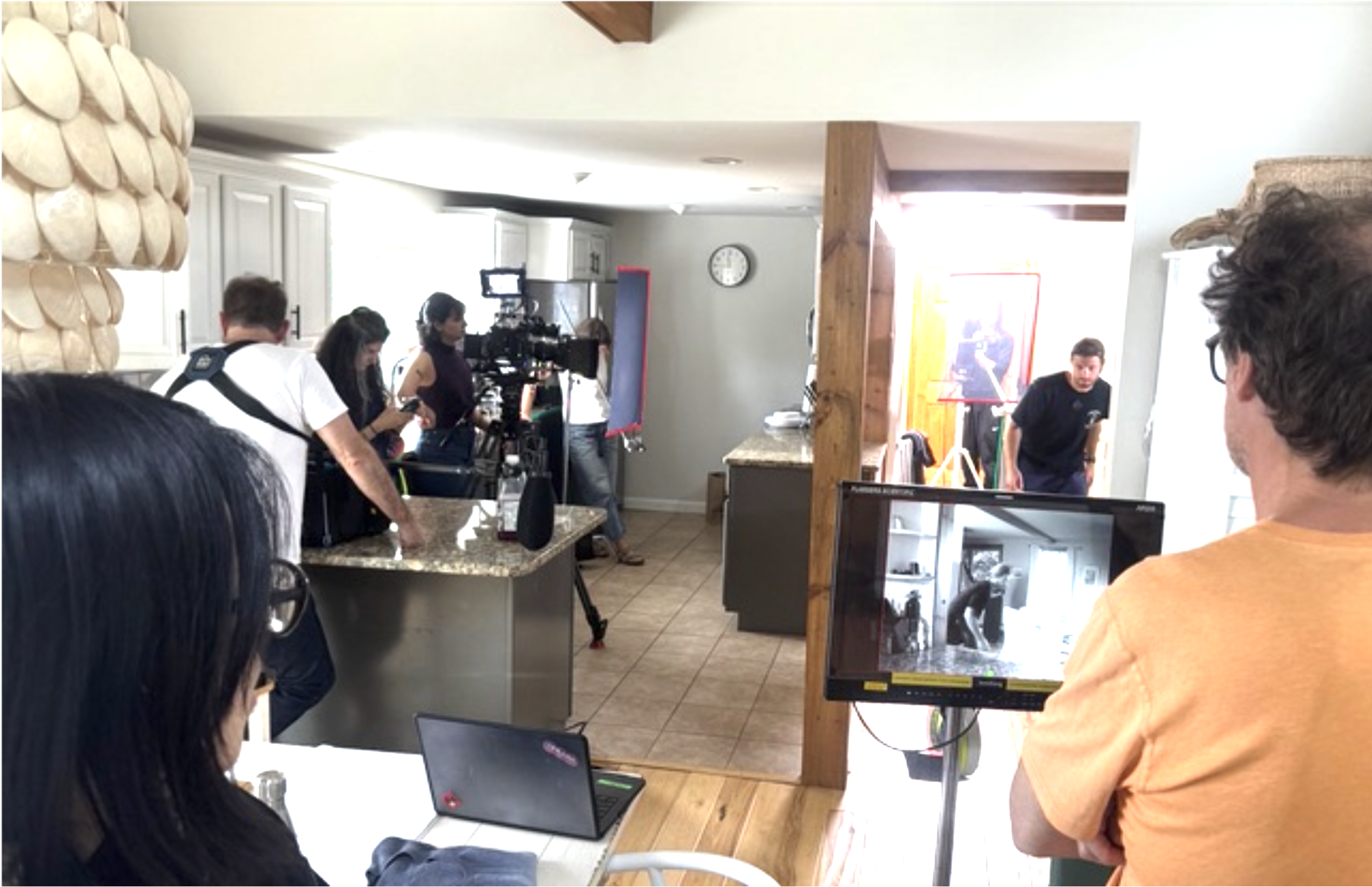
Boston-based director and cinematographer Harlan Bosmajian’s short film “Exile” debuted at the Boston Film Festival on September 20th. Bosmajian, a cinematography professor at Emerson College, first imagined the project from a short scene he wrote as an exercise for his cinematography student to practice lighting. After some time, he couldn’t escape the premise of the story and later expanded it into a film with the help of Emerson graduate student Mahdokt Molaei, one of the main actresses.
Molaei was originally introduced to the world of filmmaking as an actress in Iran. Upon coming to Emerson, she decided to put acting aside for a while to focus on exploring her filmographic voice. That is, until Harlan gave her a call.
“Harlan sent me this script, and I started talking about the character staying [similar] to my background,” Molaei said. “I’m happy that Harlan was like, ‘Yeah, this makes sense, this is something that I was thinking as well.’”
Molaei’s character prepares to house-sit for a woman (played by Julie Carpineto) who is moving to a remote town in northern Iceland with her husband. The film follows both women’s journeys with displacement and explores how they intersect.
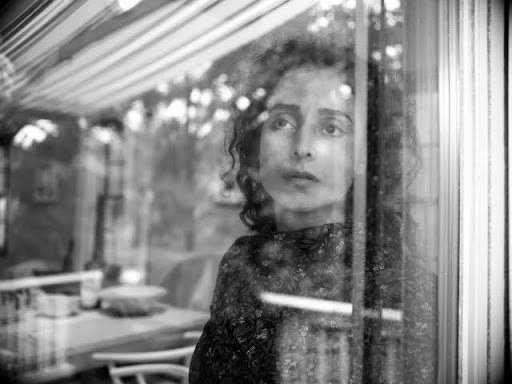
The tale of these two women may be shot in black and white, but the complexities of displacement its characters face are anything but. Molaei’s character is first heard through the rumblings and thin tones of an old phone conversation which she seems to be remembering. A man speaks of an old apartment in Tehran with crumbling wallpaper adorned with frog illustrations. Molaei says that she hopes to reincarnate as a frog, and the man asks, “And hang out on my wallpaper?” “Exactly,” she responds.
The film then splits perspective to Carpineto, whom we see talking on the phone. At the end of her conversation, she says, “I just wish in some way it was my decision too, but it’s not.” We then cut back again to Molaei delicately folding a flannel and storing it in a container reading “Ali’s things.” While explicit details of these characters’ circumstances are not force-fed to the viewer, carefully placed visual and sonic cues are enough to inform that they both seek closure for events out of their control.
As the characters meet, Molaei discovers a ceramic frog sculpture in the backyard of the house she will be watching over. At this moment, her demeanor shifts. She is no longer the poised and composed house-sitter-to-be, but demonstrates a vulnerability that allows the women to connect beyond a simple transactional arrangement.
Shaping Molaei’s character around her personal background not only brings new life to the film but also strengthens the bond between director and actor.
“Apart from the beautiful communication and negotiation with the director and writer of the film, [the conversations] brought me some trust,” Molaei said. “You feel the story as an actor […], and you feel that the director and writer of the film can understand you and the character that you’re thinking of, and that’s so beautiful. It makes you more confident to be part of that group.”
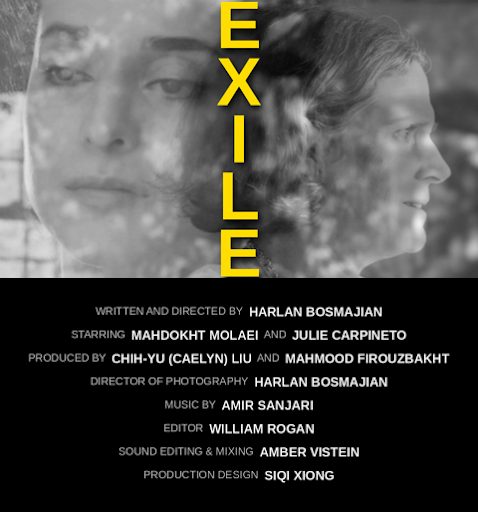
To visually emulate the diverging journeys of these women, Bosmajian chose to utilize a split-screen composition. This idea was one of his first for the film, and he took inspiration from the collage artwork of Katrien de Blauwer. Bosmajian discussed the challenge of maintaining a post-production vision of the split-screen while shortlisting and shooting on set.
“I made the mistake of DPing my own film. It’s like the thing I tell all the students not to do; I, of course, did it,” he said with a laugh. When approaching Exile as both director and cinematographer, he has a specific vision in mind.
“One of the things that I knew that I wanted to do was the split screen, but I think I didn’t fully have the bandwidth to be breaking it down on set exactly what shot was gonna work with what, I had it in the back of my mind.”
“It does a strange thing for the audience, because normally in a film, you show the audience what you want them to look at. It’s like, ‘here, look at this moment. Now look at this moment.’ But when it’s a split-screen, [the audience] is editing; they’re moving their eye from person to person depending on who they want to be looking at.” Bosmajian said.
“They choose it,” Molaei said in agreement. She shared that, although it proved to be a complicated and somewhat experimental process for narrative film, she feels that the split-screen is chosen for all the correct moments in “Exile.”
Placing so much information in the hands of the audience with very little hand-holding throughout is intentional, Bosmajian says. It is especially visible with the ending, which he and Molaei created together.
“[Molaei’s character] doesn’t give some great explanation of what’s going on in her life, and there’s not some amazing moment of connection between her and Julie,” he said. “We kind of want that as an audience, but life isn’t like that. Sometimes you have to just settle for some kind of mutual understanding that you have different lives.”
Roughly 80% of the 14-minute runtime occurs at a single location. It is here that both Molaei and Carpineto’s characters meet and discover their shared struggle in facing the loss of a home they had grown accustomed to. When it came to finding this location, Bosmajian shared that the opportunity seemed to just present itself.
“I have a friend who I’ve known for 15 years, Mahmoud, and he enjoys films a lot,” Bosmajian said. “He has a house on the Cape, and he and I would be driving back and forth, just hanging out during the summers, and our conversations led to filmmaking. He [was] like, ‘You know, Harlan, I really want to know what it’s like to make a movie.’ And I’m like, ‘Really? Okay. Interesting. I have a plan for you.’ And so I pitched him the idea of filming something at his house.”
Working mostly off of a small faculty grant, a free location was a no-brainer for Bosmajian. Creating independent work is often synonymous with creation by very limited means. Lengthy rehearsals helped to ensure that the on-set process moved quickly and efficiently, and many resources were gathered in-house at Emerson. Although this can feel stifling for some filmmakers, Bosmajian shared his love for the independent style.
“I’m a big fan of that process … You ask yourself, what do I have access to? Where can a story take place? And then, you get yourself a break and write something that works within those means,” he said.
Molaei’s acting background exposed her to varying levels of production. In Iran, she worked on many high-level industry sets, and here at Emerson, she is creating her own independent work. She shared that it takes someone experienced in both to be entirely successful in either.
“[With] the person who knows both of these mediums, everything’s gonna be okay. You can be like, ‘Okay, whatever! He knows what to do!’ And that was exactly what I thought, because Harlan knows how to make this film as an independent film,” she said.
With a successful premiere at the Boston Film Festival under wraps, Bosmajian is now determining the next steps and proper festival circuits for “Exile.” As for him and Molaei, “we’ve been talking about trying to figure out another project to do together,” Bosmajian says. While they both shared that they have a lot on their plates at the moment, they seemed confident that their journeys would converge again in the near future.
Regions: Boston