
‘Que se vayan Ellos’: Examining the Importance of Ari Cruz’s Portrayal of Puerto Rico in “Sana y Salva”
“Que se vayan ellos,” le dijo Gabriela Berlingeri.
“Let them leave,” Gabriela Berlingeri said. A simple phrase known to all Puerto Ricans, driven by the gentrification of the island, land bought for resorts, privatized public beaches and tourists’ disregard for local culture. It’s a call to preserve Puerto Rican culture and resist erasure.
Popularized from Bad Bunny’s song “El Apagón” sung by Gabriela Berlingeri, the phrase appears in Arí Cruz’s film, “Sana Y Salva” (Safe and Sound). Cruz, a well known Puerto Rican filmmaker, screened the film at the 2026 CineFest Latino Boston Film Festival. He is known for directing Bad Bunny’s short film “DeBÍ TiRAR MáS FOToS” and his portrayal of Puerto Rico through comedy and political satire.
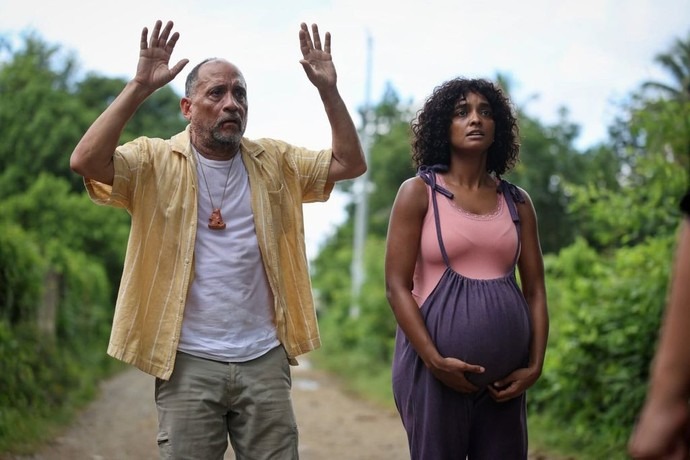
Sana y Salva covers gentrification, tourism and the nuances of immigration in Puerto Rico. The film follows Esther (Julietta Rodriguez), a pregnant Dominican immigrant who crosses into Puerto Rico in hopes to find her family in San Juan. Her journey begins on the shores of Cabo Rojo, on the island’s west side and ends with her family reunion after receiving help from interesting strangers.
In the Q&A following the screening, Cruz cited a 2021 viral video as the inspiration of his film. The video showed a boat dropping off Haitian and Dominican immigrants on the coast of Rincón, Puerto Rico. Cruz felt this story needed to be expanded.
“The subject of migration, the subject of Dominicans and Puerto Ricans and the relationship we have as sister countries,” Cruz said in an interview.“We wanted to explore it from empathy, [with] greater value for the aspects that unite us, instead of always highlighting the things that separate us.”
Cruz portrays Puerto Rico as a calm, vibrant and mystical place, though one strained by gentrification and rising tourism. In a thought-provoking choice, the film paints the police, ICE and the government as comically evil with little character depth. This focuses on them as institutions rather than individuals: individuals make up the problem, but the institution is what acts and what the focus needs to be on. This creative choice keeps the viewer focused on Esther’s journey while still providing the necessary antagonists. For example, the Governor (Laura Gómez) has a silly romantic relationship with the Police Commissioner (René Monclova); however, this relationship causes the Commissioner to try harder to catch Esther as the Governor tells him, “La quiero sana y salva” (“I want her safe and sound”).
Heightened immigration enforcement in the U.S. is a highly discussed political topic due to the denial of basic human rights, but people forget that this is also happening in Puerto Rico. Puerto Rico is a U.S. territory, but has a different relationship with Caribbean neighbors than the U.S. mainland does. Their cultures are intertwined. Food, music, language, dancing are just a few of the things they share. “Sana Y Salva” showcases this cultural reality vividly.
In fear of deportation, Esther spends most of the film focused on one thing: reaching her destination. She is slow to trust those around her and keeps to herself. But along the way she meets people like Arcadio (Mario Guerra), an old Puerto Rican man who helps her to San Juan and makes sacrifices along the way. He opens her eyes to a realization about the island beyond her initial grasp.
Originally, my question for the Q&A pertained to another upcoming Puerto Rican film titled “Porto Rico” directed by singer and previous collaborator of Cruz’s, Residente. The film follows José Maldonado Román’s life as a Puerto Rican revolutionary who leads a gang of ex-convicts in the fight against Spanish colonialism. According to Puerto Rican journalist Rafael Lenín López’s report, the Puerto Rican government blocked the film from shooting on the island, forcing the production to film in the Dominican Republic instead. López states that the Puerto Rican Film Corporation, a government office, told Residente “not to count on any support.”
A government blocking a film because it disagrees with the film’s message is problematic to say the least. Yet through “Sana y Salva,” Cruz shows that the piece of land truly doesn’t matter. Though the film highlights gentrification and tourism, near the end of the film Esther describes how she’s able to envision her Dominican Republic homeland in Puerto Rico.
Cruz’s film was almost entirely filmed in Puerto Rico, whereas “Porto Rico” won’t have that same privilege. But Cruz answered my question without being asked. It doesn’t matter where “Porto Rico” is filmed, Isla del Encanto (Puerto Rico) can be seen everywhere.
Regions: Boston, Los Angeles, New York City, Puerto Rico, United States