
Open Roads Italian Festival May 28-June 4
Lincoln Center’s 25th Italian fest proves eternal cinema themes endure for eternity
Dollar for dollar, year after year, Lincoln Center and its curating partner in Rome, Cinecitta, have been delivering among the most tightly curated packages of Italian art cinema—barely over a dozen feature films this year—to be seen anywhere in NewYork City. What’s Open Roads’ secret?
Your critic used to think the magic happens because one set of curators in Rome keeps the other set of curators in Manhattan honest, and vice versa—sort of like FLC partnering with The Jewish Museum for the New York Jewish Film Festival, with Unifrance for Rendez-vous with French Cinema, and with the Museum of Modern Art for New Directors/New Films. No question having two sets of institutional cinephiles conscious of the other institution’s aesthetic has helped build the excellent slates of dramas, docs and shorts up on their big midtown and upper Manhattan screens. FLC Programmer Dan Sullivan says this Open Roads slate “offers some interesting propositions about the present and future of Italian cinema, while also deeply engaging with its incomparable past.” Cinecitta’s CEO Manuella Cacciamani calls the slate “young, experimental and full of new energy. And there is a towering masterpiece, Paisan, by Roberto Rossellini. A film that, 60 years ago, captured Italy with striking immediacy.”

And so the core reason for the magic seems to transcend CEOs, curators, distributors, exhibitors, tastemakers and critics, and reverts back to the filmmaker. Writers, producers and directors—veterans as well as newcomers, whose work is displayed here—have taken familiar, universal themes (just as Rossellini did) and executed them in fresh, urgent and innovative ways. What the rest of us do is try and call up our best responses. Ultimately you, the enlightened viewer, makes the call on whether to pause streaming and make a brick-and-mortar big screen your end destination for a whole afternoon or evening. It takes more and more enlightened viewers to make an art cinema festival of any size into a profitable venture. These three critic’s choices are a clarion call on how eternal cinematic foundations, freshly minted, can surprise us all, popping up as the hottest open roads in town.
Elisa: Leonardo Di Costanzo: 2025: Italy, Switzerland: 105 minutes.
Eternal theme #1: The true crime psychological thriller
America first tuned in to true crime stories via 1930s radio programs like“Gangbusters” and slick paper newsstand magazines like Master Detective, heavy with real-life photos and narratives re-created by writers who crafted “as told to” narratives spun out by law enforcement officers. The one fictional crime writer who honed his below-freezing, clinical voice re-creating true crime stories was Jim Thompson. An Oklahoma alcoholic best known for the novel (and movie) The Killer Inside Me, Thompson carved out a path for world-class novelists Norman Mailer and Truman Capote, who birthed the “invented” true crime novels The Executioner’s Song and In Cold Blood. Both delved deep into the minds of murderers. The 1967 film of Capote’s In Cold Blood was the godfather of the recent bristling, visceral crime drama Saint Omer, exploring why a Black mother played by the astounding Guslagie Malanda decides to kill her newborn baby.
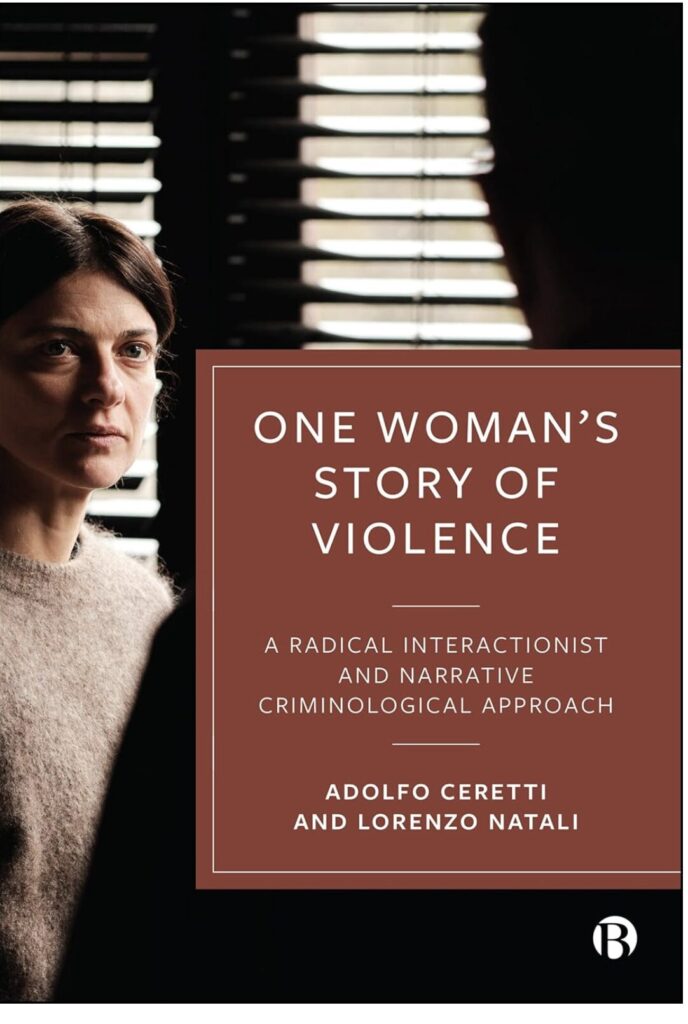
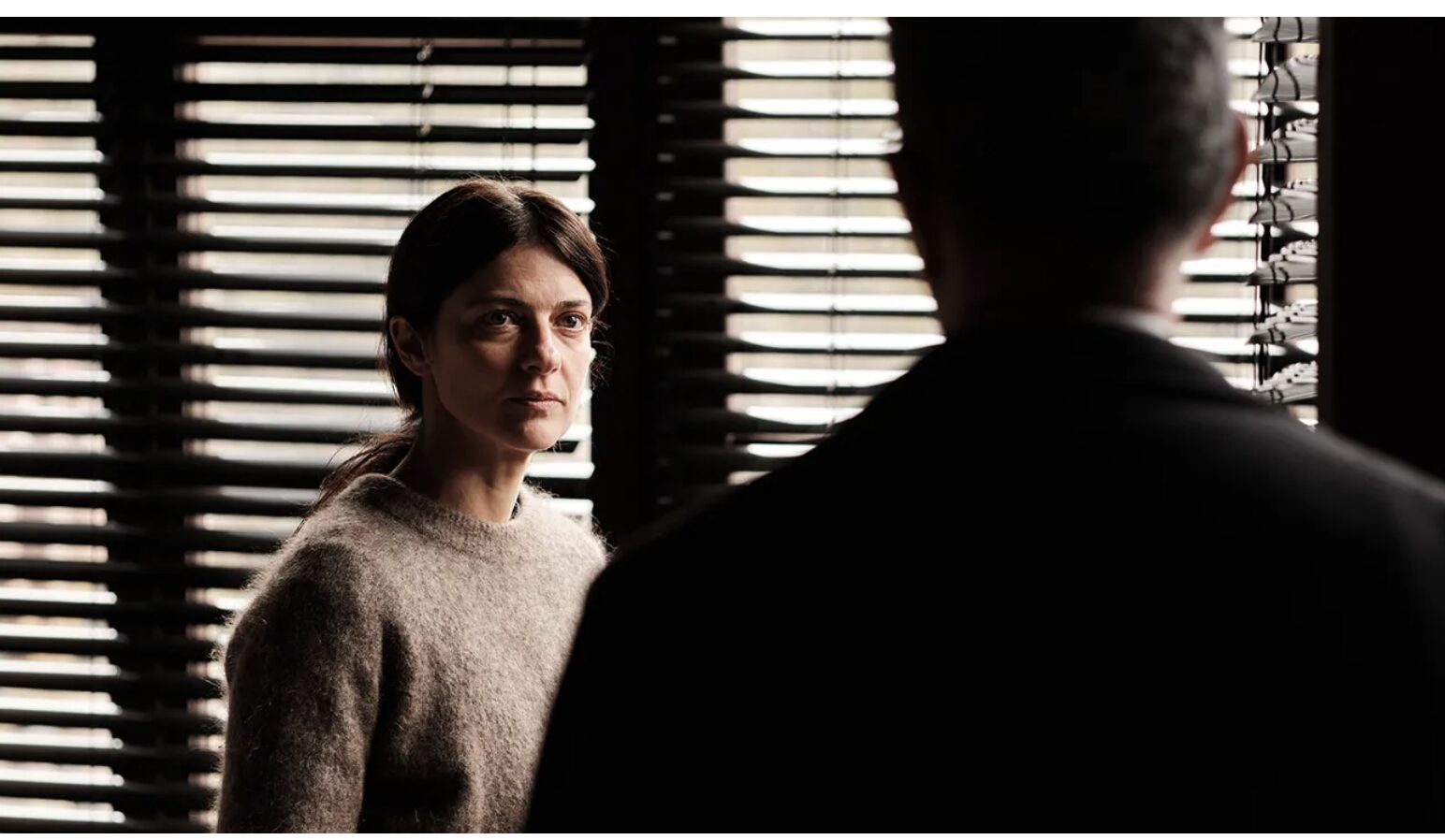
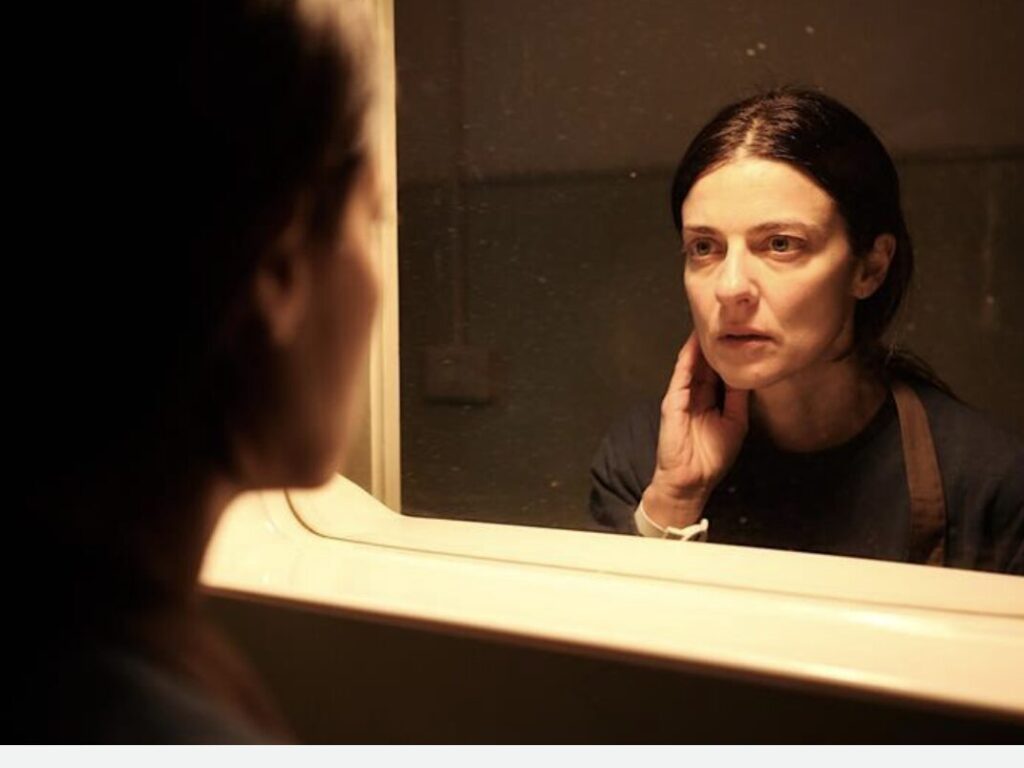
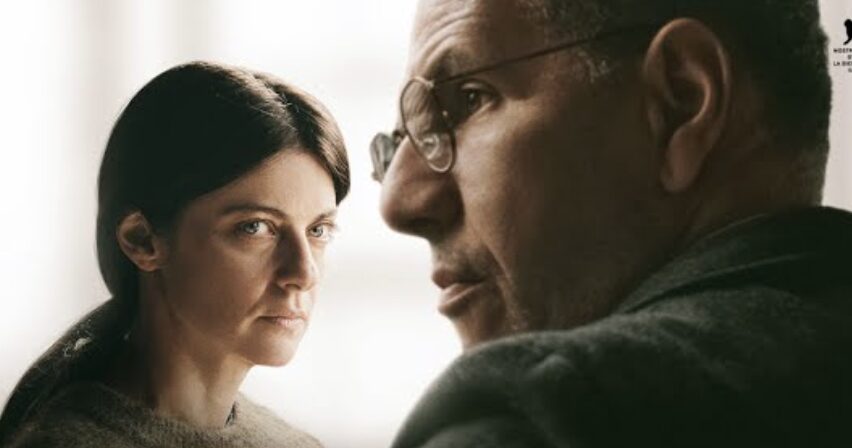
Elisa is the latest heavyweight addition to this chilling canon. It’s inspired by the book One Woman’s Story of Violence, by Adolfo Ceretti and Lorenzo Natali, both academic criminologists at the University of Milano. They’re experts in the study of restorative justice, in which trained analysts help convicted murderers understand why they killed. Elisa is nearly a two-hour immersion centered around therapy sessions between Alaoui (Roschdy Zem, most recently in Other People’s Children and never better), a visiting university professor at a low-security rural prison in the Swiss Alps, and Elisa (Barbara Ronchi, the breakout star of this Open Roads). She’s ten years into serving a 20-year sentence for kidnapping, killing and burning her sister’s body, and also trying to murder her mother the same way. Elisa’s story and screenplay by Constanzo, Bruno Oliviero and Valia Santella grows out of Ceretti and Natali’s research, available on Amazon with a convenient movie tie-in cover.
Di Costanzo is no stranger to prison dramas; his Iron Cage, a drama of convicts awaiting transfer to another facility, was an Open Roads selection four years ago. (Don’t let Elisa confuse you with the festival’s Opening Night selection, Carolina Cavalli’s The Kidnapping of Arabella. Cavalli’s movie is about a 28-year-old who runs off with an amusing motormouth 8-year-old. If David Lynch had made a likeable children’s movie, it would have looked and felt like Arabella, which is affable and full of goofily familiar Lynchian oddballs. It’s an easy sell to art house audiences.) Elisa is hard work, requiring unblinking concentration, but the rewards of its infinitely more complex story make it the one you’ll remember.
Elisa is a docile, nearly mute prisoner who’s been assigned one of the penitentiary’s rustic cabins—a pretty cushy setting that’s hardly solitary confinement. She tends a morning coffee bar for the other inmates. She’s not seeking early parole, which is possible even for convicted murderers. Her dad visits her regularly, and dotes on his youngest daughter, having once given her a majority stake in the family’s sawmill business when she was barely an adult.
We learn from Elisa’s conversations with Alaoui (embellished with brief flashbacks) that her mom (Monica Codena) never wanted another, third child. She got along with her brother (Marco Brinzi) but was estranged from her sister (Roberta Da Soller), who left home at 15. When the sawmill foundered and failed, Elisa blamed herself. But she engineered an ingenious plot to shift the blame to her sister. When this too failed, Elisa snapped and extinguished the sister she’d drugged and locked away. When mom blundered in with one last rant, Elise lost it again, thinking she’d destroy both women and scrape together a new life of her own.
Director Di Costanzo lays out these grim basics with restraint and patience. We’re watching two marvelous actors inhabit their roles with flawless delicacy and finesse. Ronchi has a rare gift for communicating eureka moments with the tiniest shift of an eye, lip or hand. She’s immensely aided by the muted and careful lensing of Luca Bigazzi and the unobtrusive and unhurried editing of Carlotta Cristiani. Another plus is Giorgio Matteo Oliviero’s music, which you barely hear but subconsciously feel. Its subtle instrumentation helps you through many difficult scenes.
Di Costanzo also inserts a second, important female, a visitor to the prison who attends Alaoui’s lectures at the start and close of the movie. This is Laura, acted by a stalwart of Italian cinema, Valeria Golino (she’s in three other dramas in this fest). Here Golino plays an unforgiving mom whose son was killed by thugs and who refuses to understand why any learned academic and author would try to rehabilitate and justify an evil murderer. She’s the movie’s stalking horse, or its moral conscience—depending on how you reject or accept Alaoui’s concept of restorative justice. Kudos to Di Costanzo for anticipating and honoring an opposing viewpoint by giving it space and time, as well as a persuasive performance by a veteran actress.
True crime became a movie staple half a century ago. Elisa raises the bar a little higher for filmmakers today.
A Brief Affair: Ludovica Rampoldi: 2025: Italy: 100 minutes
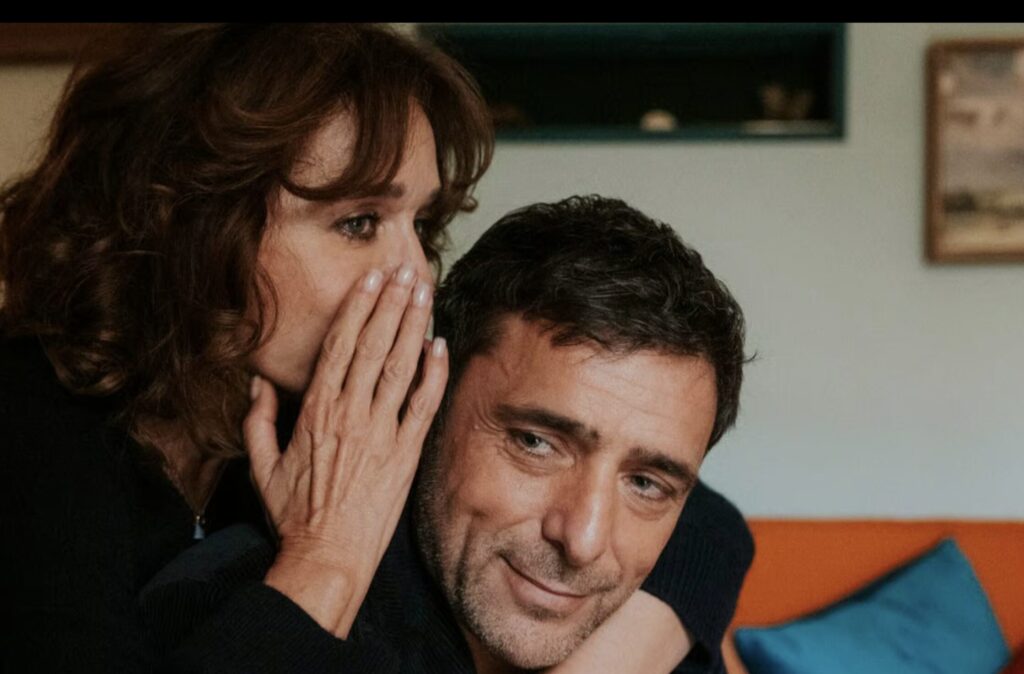
Eternal theme #2: The adultery tale
And you thought the French had a lock on infidelity movies. Not for a minute, Ludovica Rampoldi makes an authoritative directing debut that demands and holds your attention all 100 minutes. Her last work shown here, as a writer, was the towering (and critic’s choice) crime revenge saga, The Traitor. Here she’s directing the most sophisticated script in this festival. Rampoldi boldly describes it as “thriller and irony, drama and romantic comedy.” She’s not kidding—A Brief Affair is all this and more, with four standalone actors fully capable of seducing any art cinema viewer in the room. Add in music composed by Fabio Massimo Capogrosso that moment by moment tucks itself under Rampoldi’s ever-changing moods. The score is its own satellite of pinpoint, nearly subliminal seduction.
Here’s the setup. Lea (Pilar Fogliati) finds herself in a tony bar next to a fancy chess boxing club (like Gleason’s Gym on the Brooklyn waterfront), where two buff guys play chess next to a boxing ring, then climb through the ropes and pummel each other, then settle back down to finish their chess match. Lea’s working on her third gin and tonic and not thinking about her movie star partner Andrea (Andrea Carpenzano) and their daughter sleeping at home. She’s eying the handsome boxer/chess winner, Rocco (Adriano Giannini) and thinking about coaxing him into a by-the-hour hotel. Except she can’t remember where she parked her car.
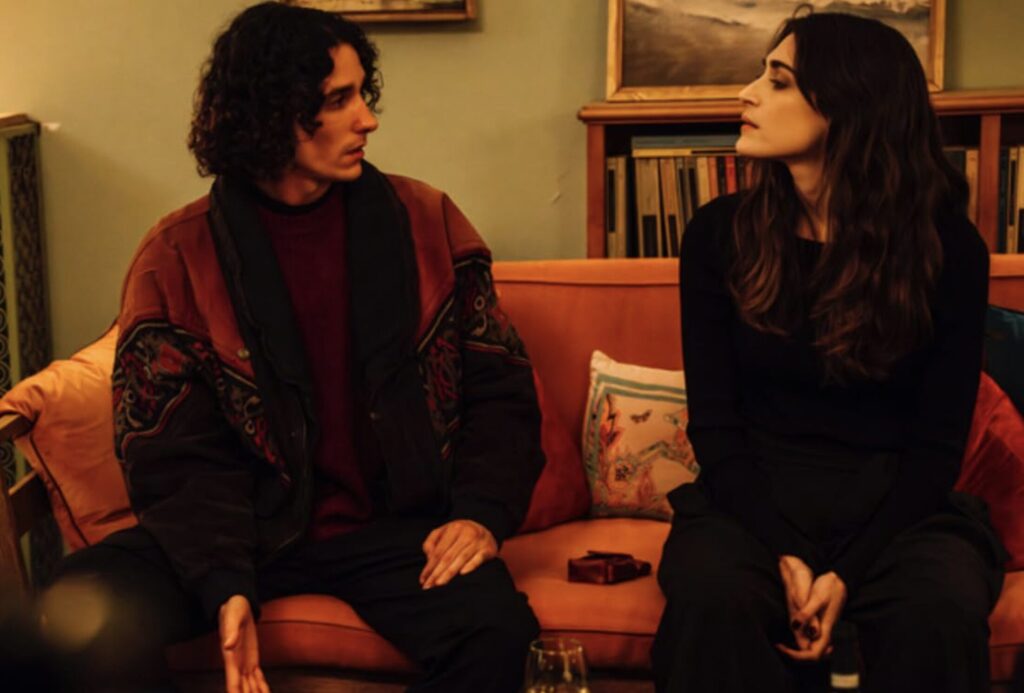
Like the good married gentleman he appears to be (he’s a seismologist at a geophysics institute, studying earthquakes), Rocco helps find her car and even plays her sober driver. He doesn’t quite resist a thank you kiss that promises much more. He’s been married 19 years to Cecilia (Valeria Golino, again splendid, cast here as a psychoanalyst). Rocco was once her patient. She lives with his quirks, among them chess boxing and the home ant colony he thinks may predict earthquakes.
Lea turns up outside Rocco’s office the next day, and this time he does let her take him to a hotel. We learn she’s a published best-selling author whose side hustle is “interviewing distinguished women for a magazine with fewer readers than this hotel has guests.” She says she’s never cheated before, but believes her actor husband is bedding one of his many sexy on-screen actresses. Rocco admits to one night affairs but cites a “rule of three”—three being the juncture “where a fling becomes a relationship.” He tells her no other woman ever made it to a second.
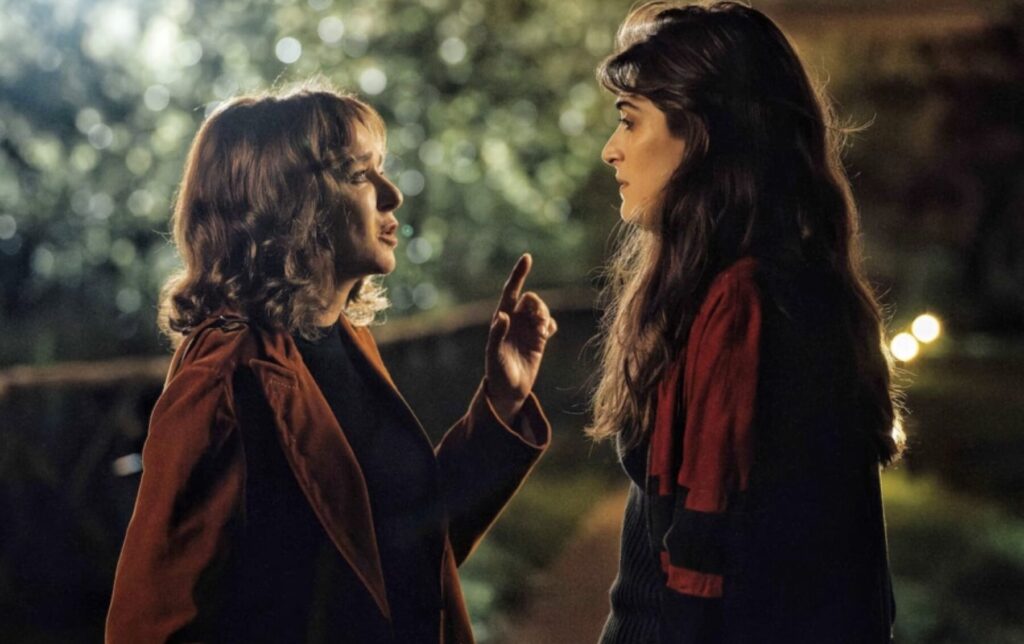
But Lea builds the count, insinuating herself into Rocco’s life by leaps and bounds. She watches him from an adjoining office building. She stands in a church service Rocco and Cecilia attend, staring daggers. She talks Rocco into letting her explore the couple’s apartment and flopping onto their bed. (She also accidentally pulls down the ant colony tank, unleashing ants all over the apartment, one of Rampoldi’s not-so-subtle ironies.) She’s even nervy enough to hire Cecilia for counseling, slyly confessing she’s fallen in love with a married man. She adds this is happening in part because she believes her husband is seeing another woman. She asks Cecilia’s advice. At which point writer/director Ludovica begins to twist and turn her plot in a hugely unexpected direction, which your critic wouldn’t dream of revealing.
A Brief Affair is a tightly dispassionate observation of 2026 unfaithfulness. It has a different onscreen title, which in Italian translates to Short Love Story, a rather different way to ponder Lea and Rocco’s indiscretions. A Brief Affair isn’t an inaccurate title, but it’s judgmental in a way the movie isn’t. While Cecilia and Rocco don’t have an open marriage, the analyst candidly admits they’ve “stopped having expectations of each other.” All of her clients are divorced, and she freely offers opinions like “betrayal is a victimistic misinterpretation.” She counsels patients that faithlessness is often a response to fear of living. In this icily alert dissection of the double lives and double crosses adults commit, It’s not surprising that when Lea begins stalking Cecilia as she did Rocco, she finds the analyst at a shooting range, learning how to hold, aim and fire a Glock. Probably it’s Cecilia’s version of chess boxing.
I Want Her Dead: Gianluca Matarrese: 2025: Italy: 86 minutes
Eternal theme #3: The neighbor-from-hell nightmare
Every New Yorker has a neighbor from hell story. It’s practically inevitable, given the density of Manhattan residences that seem to rise higher than some airlines fly—apartments stacked side by side, one on top of another, ever skyward, block after block. But what if your building’s residents included one 70 member extended family, housed side by side and one on top of another, in an upscale midrise abode in Calabria? I Want Her Dead should wear a smiley face embedded in its upfront printed screen quote from Antigone, “There is no worse end than a divided family.” Matarrese wins this critic’s Good Guy Director Award by making—at long last—a neighbor-from-hell tale we can chuckle along with. For it’s two raging sisters-in-law, living one above the other for ten years, slowly driving each other nuts.
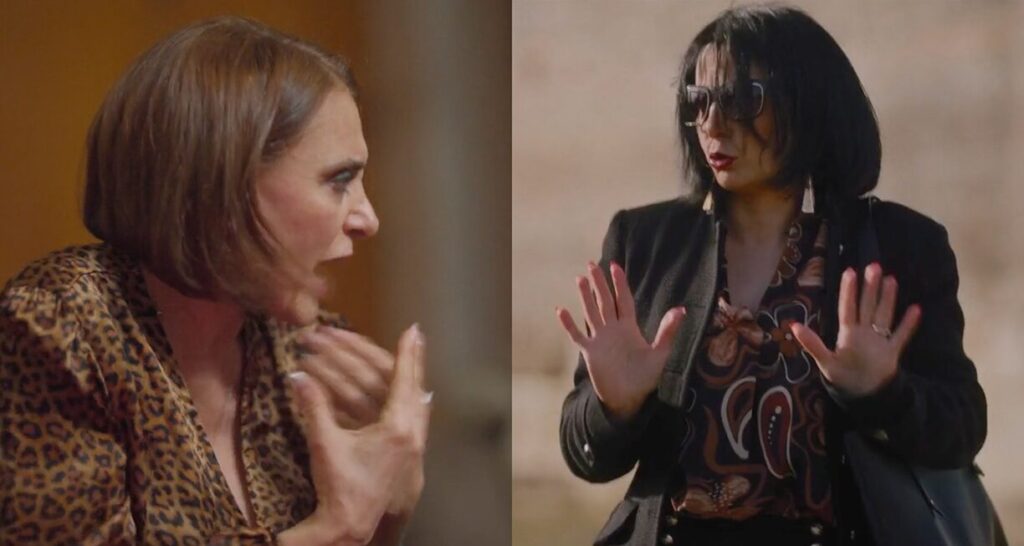
Look at their photos. They’re squaring off against each other, like two well-trained and inexhaustible boxers the whole family occasionally pauses to stare at in wonder. Upstairs it’s Luisa (Maria Luisa Magno), shown on the left. She’s a reasonably well-off divorcee without children, who makes her living peddling a variety of household goods on some undefined platform. At the right is her downstairs neighbor, Imma (Immacolata Capalbo), also relatively well-off, with a low-key, long-suffering husband and two sweet school age kids. In her spare time Imma gives a first-aid course and visits the elderly.
Their opening set-to runs seven minutes and grows in intensity, venom and volume throughout the movie. “Our family is a train she got off of five stops ago” bellows one. “She’s a boorish scumbag” booms the other. Both 50-something women have salty mouths and let fly strings of profanities The New York Times once condemned as “barnyard epithets” and refused to publish. Both actresses have wickedly assured comic presences and timing, and both are adept at throwing a barrage of below-the-belt sucker punches at each other, courtesy of Matarrese and Nico Morabito’s clever and knowing screenplay. The film also provides a bouncy, playful music score by Cantautoma that gives you permission to laugh out loud at quality-of-life issues you’d find intolerable if they were happening to you.
Here are the bones of contention: Both women share a common electricity Iine, and the bills are piling up. Both claim the other cut the electrical wiring, and each accuses the other of leaving a shears next to the meter. Imma claims Luisa shakes out her carpets over her balcony, covering it with debris, and that Luisa’s apartment also has a water or toilet leak. Not to mention that Luisa threatens to kill Imma’s family dog for peeing on her car parked next to their building. Luisa claims the smells from Imma’s kitchen carry up into her home and are making her sick. She adds “both my brother and his dwarf wife are crazy.” Both sisters-in-law will file complaints with the local magistrate. Luisa suspects Imma is sleeping with the magistrate. Each woman takes her grievances to court, which of course is looking for proof and witnesses to all this never ending misery. The rest of the family stands mute. They’re family, after all.
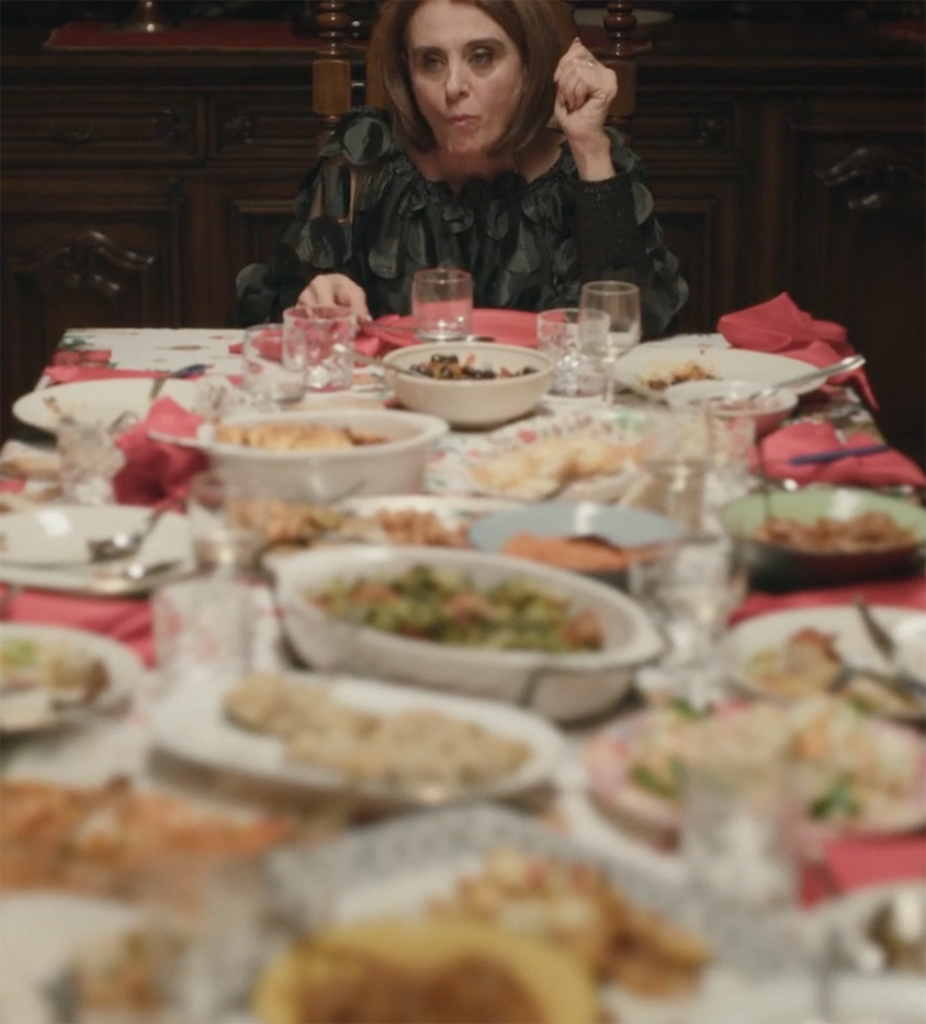
Maybe because Matarrese slyly sets up all this turmoil between Christmas and New Year’s, the one diversion for everyone is food. Like regimented prize fighters, Luisa and Emma stoke up between rounds. Everyone in this traditional family lives for home cooking. And so we sit through one incredibly extravagant meal after another—see photo—and the women sometimes go at each other over their pasta. (Like a lot of dysfunctional families in Calabria, Manhattan and the rest of the planet.) The saving grace of I Want Her Dead is that it’s a breather—even better, a breath of fresh air—from getting along with, or not getting along with, the neighbors we inherit. In bocca al lupo!
This concludes critic’s choices. Watch for Brokaw’s picks in the 25th Tribeca Festival, June 3-14.
Regions: New York City