
DOC NYC Nov. 11-29
The four legendary documentaries in Manhattan’s 200+ film doc fest all start with legends
A few highlights from America’s largest documentary festival, now rolling out 115 feature length documentaries and 89 shorts at in person showings through Nov. 19 (IFC Center, SVA Theater, Village East by Angelika) with online screenings continuing through Nov. 29 and available to viewers across the US. The Lifetime Achievement Awards went to Alex Gibney (Musk, Taxi to the Dark Side) and J.T. Takagi, the veteran sound recordist, filmmaker and executive director of Third World Newsreel. The Robert and Anne Drew Award for Documentary Excellence was presented to Stephen Maing (The Great Experiment, Union) and the Leading Light Award to Raney Aronson-Rath, the executive producer of PBS’s flagship investigation series Frontline.

Among DOC NYC’s major media partners and sponsors are THIRTEEN, Apple Original Films, HBO Documentary Films, Outlier Film Fund, National Geographic Documentary Films, Variety and Netflix. DOC NYC is produced and presented by IFC Center, a division of AMC Networks.
Three Manhattan festivals have now crossed the 100-movies-and-up line: The New York Film Festival, Tribeca, and DOC NYC. All three have doubled and tripled their offerings to bolster ticket sales, knowing reviewers as well as most paying customers will see only a tiny fraction of what’s offered. Like Tribeca, DOC NYC has adopted a hybrid screening schedule. And DOC NYC and Tribeca are not averse to dropping ticket prices to five dollars on docs that might otherwise be dead-on-arrival. Some viewers say that changing what were once highly selective festivals into staging grounds for eventual streaming are all but ruining the concept of art cinema.
Here are critic’s choices from the 2026 DOC NYC:
Once Upon a Time in Harlem: William Greaves and David Greaves: 2026: United States: 105 minutes
The last major hidden-in-plain-sight documentary to have been resurrected from total obscurity was Summer of Soul in 2021. That doc was about an annual Harlem music festival, started in the summers of ‘67 and ‘68 in Marcus Garvey Park by a local singer and NYC Parks Department employee, Tony Lawrence. The concept of Lawrence’s ‘69 edition was to widen an annual bill of gospel, soul and blues artists into a more newsworthy slate that would open doors to international tours promoting Black music to the world.
And so the summer ‘69 weekend lineups included bigger headliners like Sly and the Family Stone (fresh from a Woodstock appearance to 450,000), Hugh Masekela, The 5th Dimension, drummers Max Roach and Ray Barretto, activist singers Abbey Lincoln and the more volatile Nina Simone.
The concert’s NYC videotape producer, Hal Tulchin, touted the show as a ‘Black Woodstock,’ but music buffs thought it was closer to a chart-climbing Harlem Renaissance. And it went nowhere. For years the cans of high definition, two-inch tape sat in Tulchin’s basement, until Questlove dug his way into this treasure trove of artistry, reassembling it into Summer of Soul, his debut feature. Searchlight Pictures snapped it up.
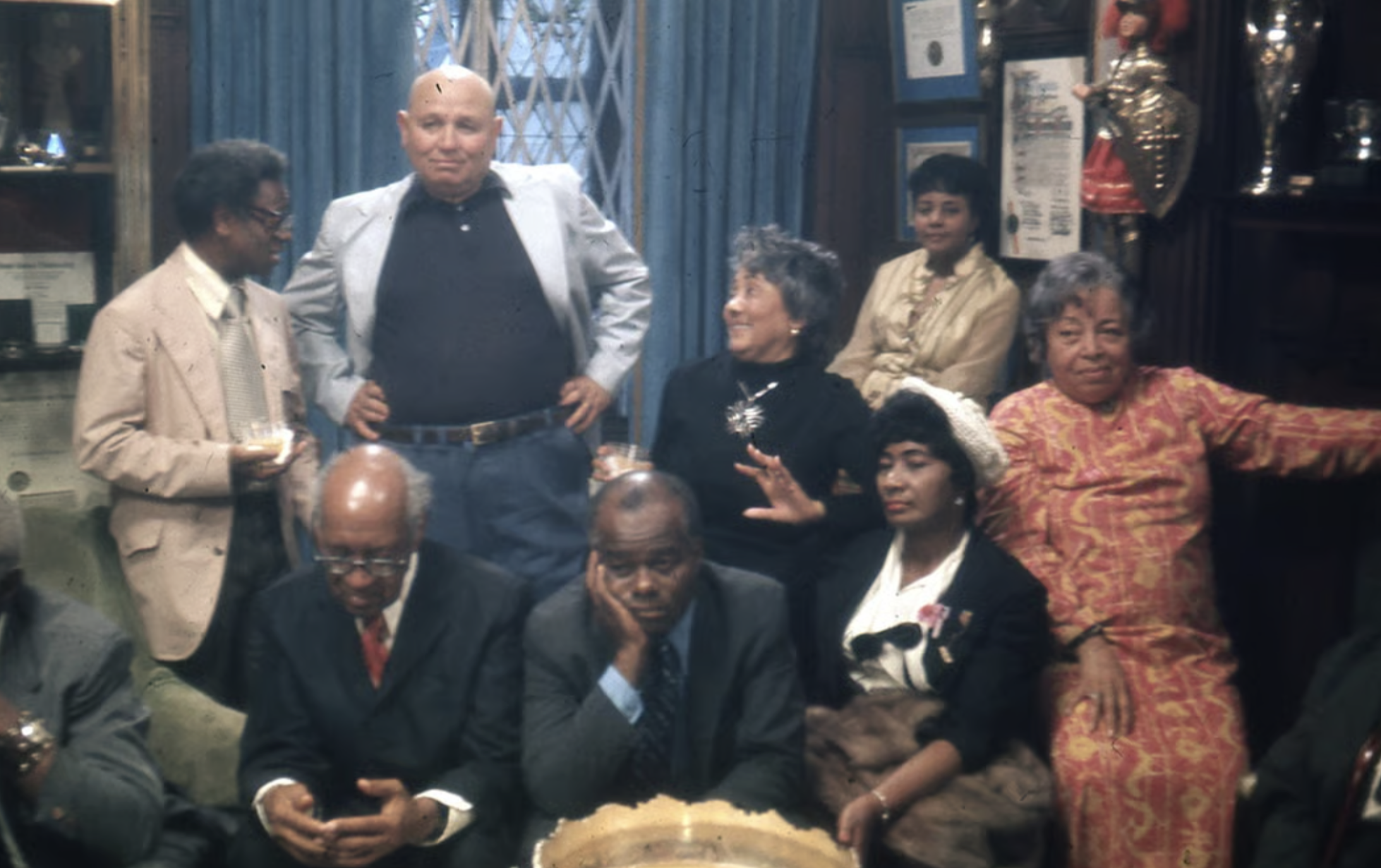
Just three years after the Harlem music shows, in the summer of ‘72, the filmmaker William Greaves sent out cocktail party invitations to a variety of cultural and artistic figures who’d been a part of the original Harlem Renaissance, generally acknowledged to be 1918 through 1929 and the start of The Great Depression. His plan was to film the four-hour get-together in 16mm, in Duke Ellington’s elegant publishing home on West 106th, near Riverside Drive.
After the convivial afternoon, Greaves went on with his prolific career, crafting over 40 docs (many on prominent Black figures) until his passing in 2014. He never finished assembling that momentous afternoon reunion in 1972. William’s son David, who was on camera filming the original gathering with his dad, took on the task of completing the film. A granddaughter, Liani Greaves, produced. Once Upon a Time in Harlem had its Manhattan premiere at this season’s New York Film Festival and has found homes at the Lincoln Center Munroe theaters uptown and Film Forum downtown. Neon is distributing, which is probably the ultimate to-die-for wish of 200+ other features in this DOC NYC.
David quotes his dad on why the elder Greaves filmed the gathering: “I saw myself as part of a process in which Harlem and the artists of the Renaissance were at the forefront of our people’s search for identity and recognition. I now see that culture is what defines people, and I see this film as an exploration and an appreciation of African American culture and the role the artist plays in creating that culture and defining who we are as a people.”
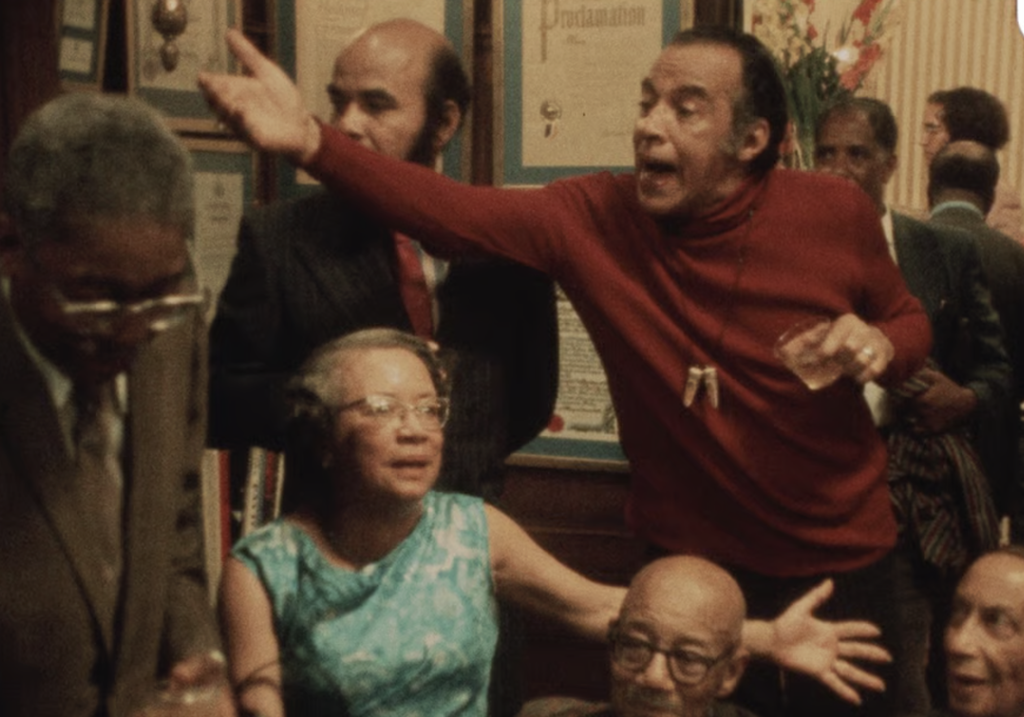
As you can sense from the two film images shown, it looks like and was a gathering of cultural pioneers. One should point out that younger jazz buffs may not recognize many names who dropped in that afternoon in 1972 other than Duke Ellington (who isn’t there though his sister, Ruth, is), and Eubie Blake, the ragtime pianist who’s very much present at 85 and is marvelous. Young scholars might be more familiar with other icons who are talked about but absent, like poet Langston Hughes, author Claude McKay, and the controversial author/photographer Carl Van Vechten. There are tributes to Black nationalist Marcus Garvey which will bring smiles to any viewer recalling Summer of Soul took place under the trees of Marcus Garvey Park.
Once the partygoers settle in, the action slowly centers on one room where each painter, poet, actor, historian, librarian, bookseller, singer, and educator (plus one member of President Roosevelt’s Black cabinet) sprawl out, let their hair down and forget Greaves’s cameras and boom mics are capturing it all. Ida Cullen, the widow of acclaimed poet Countee Cullen, demands attention be paid. The directors make It easy for you, supering names repeatedly until you remember who’s who, and splitting the screen to show you the person speaking and how that person looked 40 years earlier.
Every guest has a different take on what the Harlem Renaissance meant, but there’s general agreement it took a lot of heavy lifting in hard times by the founding artisans of Harlem to fuse together a recognizable movement. Each individual speech teaches a truth, in what becomes a graduate seminar led by master teachers. We look at examples of the incredible portraits by photographer James Van Der Zee, and watch and listen with wonderment as 95-year-old actor Leigh Whipper recites from memory his entire speech as Ethiopian emperor Haile Selassie in the 1943 movie Mission to Moscow. Bookseller Richard B. Moore, probably the best-read historian in the room, opened the Frederick Douglass Book Center in Harlem, becoming a preservationist just like the Greaves.
The contributions that afternoon are profoundly rich and deep, and there’s the sense everyone is bearing witness at Duke’s half a century ago, hoping someone in the future will similarly bear witness and remember this remarkable time in a community’s history. It’s doc cinephiles like Greaves and Questlove who dig up the subjects that count, especially the ones hiding or not hiding in plain sight.
All The Music In The World: Joseph Levy: 2026: United States: 83 minutes
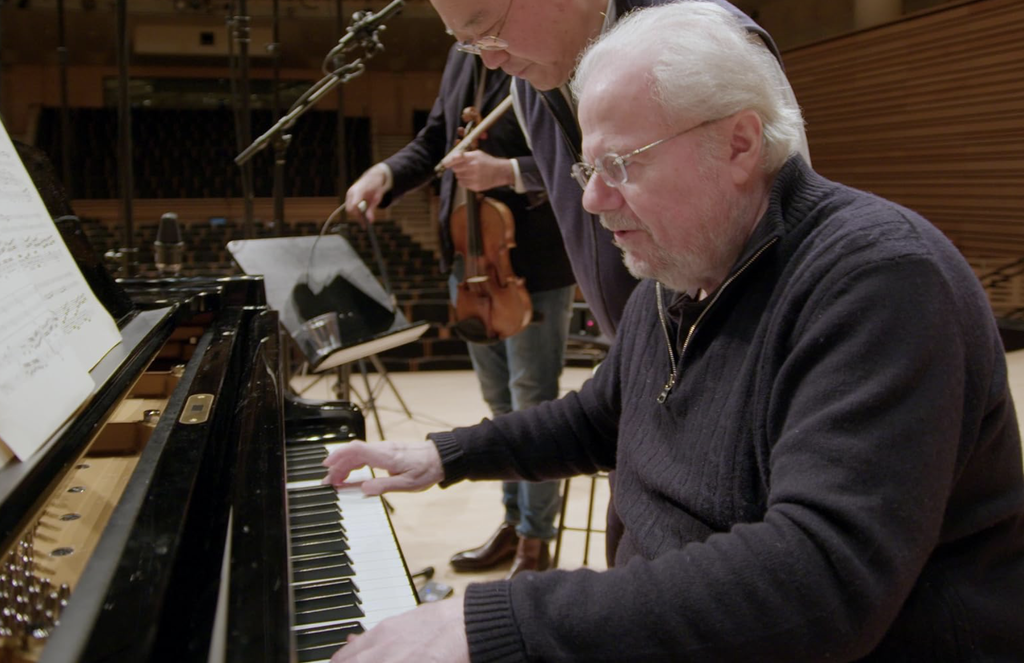
As Manhattanites we tote up our 1,001 artistic treasures. Without question the pianist Emanuel Ax is high on any list, one reason of many we wouldn’t consider living anywhere else. The preeminent classical concert musician known as Manny—don’t call him maestro, he doesn’t like the word—has made the city his home since his parents brought him over as a child from Ukraine and moved into a high rise on 57th Street, directly across from—where else?—Carnegie Hall.
Ax met Yoko Nozazi, a chamber music pianist, up Broadway at Julliard, and married her 50 years ago. He started out haunting Carnegie concerts, still practices three to four hours a day, and by his count has played Carnegie 123 times, mostly to sold out audiences. “Everything you practice seems easier than the piece you’re about to play,” he avows, a line Yogi Berra would have warmed to. Manny has the warmth of Yogi, and has been spotted often, standing in line with his groceries, at Zabar’s emporium on the Upper West Side.
All the Music in the World is a brilliant summing-up documentary, a supremely sublime and touching look-back at an unparalleled career, as well as an intimate glimpse into the offstage life of a devoted husband, father and grandfather. Ax has introduced generations of students to Beethoven, Chopin, Liszt and Schumann, samples of whose works are included here. The picture is directed, written, co-produced and edited by Joseph Levy, a cellist and filmmaker best known for a short, George Lucas in Love, which he produced in 1999. It’s made over half a million dollars in VHS and DVD sales, online distribution, plus TV, theater and festival licensing, becoming the highest grossing short in movie history. Maybe Levy should have titled this fest feature Emanuel Ax in Love, because It’s about another artisan who loves music as much as Lucas loves movies.
This modest 83 minute look back is filled with ineffable pleasures, cross-cut with one growing and rueful surprise. The pleasures are Ax performing at the top of his game with symphony orchestras and with his 50-year friend and occasional artistic partner, cellist Yo Yo Ma. Ax and Ma, joined by Leonidas Kavakos, fill four separate film segments as “Beethoven Plus Three,” rehearsing and recording the first chamber work written around 1800 for piano, cello and viola. This is a deep dive into the creative process—how master musicians seamlessly collaborate as they record, play back and nuance their work to near perfection. Take #44 in one segment seems like the keeper.
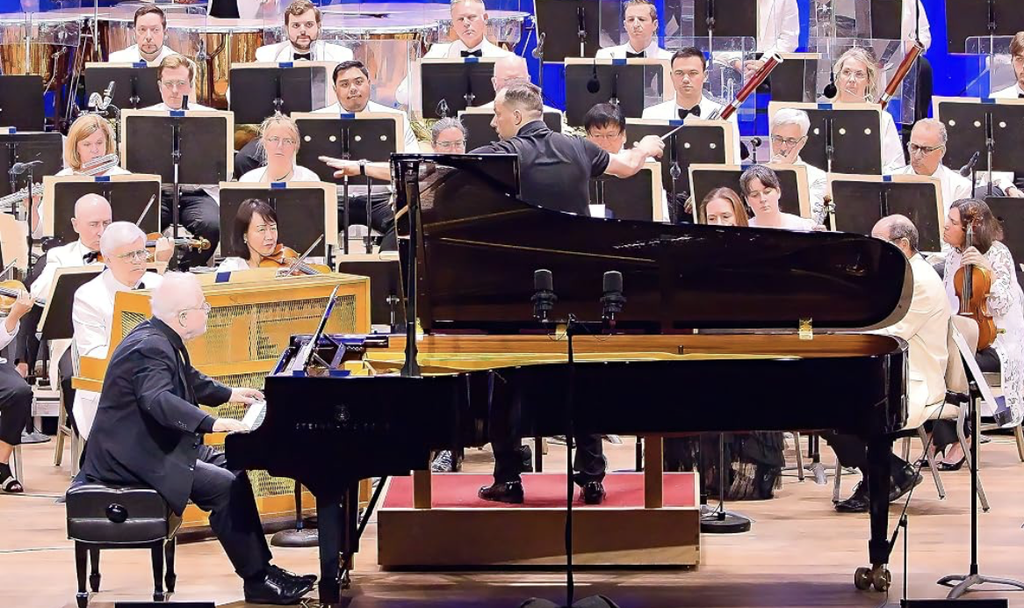
The surprise begins with famed movie composer John Williams, winner of five Oscars, announcing he’d written a concerto for piano and orchestra for Ax to perform with the Boston Symphony Orchestra two years ago at Tanglewood. Ax admits to a lifetime of nervousness before he goes onstage performing anything. Williams started as a jazz pianist and has filled his 22 minute tribute to Ax with references to jazz greats Art Tatum, Bill Evans and Oscar Peterson. Initially Ax is not just scared but thunderstruck. Yet he practices the piece for a whole summer and pulls off Williams’s fast, complex composition without a hitch—and beautifully.
It’s during this unusual concert that director/editor Levy begins sliding in scenes of the people closest to Ax, each questioning how much longer the 74-year-old traveling workhorse can (or should) continue playing all the music in the world, all over the world. Ax admits to finding intense pleasure when the first seasons of COVID all but halted concerts globally, and Manny took refuge in the family’s rural retreat. He’s defensive when he tells us Arthur Rubinstein kept walking onto stages for 70 years until declining vision finally silenced his piano at 89. But you can also see how Ax takes a childlike glee in making pasta with his grandchildren. The takeaway from Ma, his close friend and legendary violinist Itzhak Perlman, daughter Sarah, son Joey, and wife Yoko all tilt toward Manny moving from the fast lane to a slower lane, while there’s time. Levy’s shaped his film suggesting Ax take it easier, as the mature and lavish gift it is to lovers of classical music everywhere.
Robert Richardson: The White Devil: Jana Hojdova: 2026: United States: 105 minutes
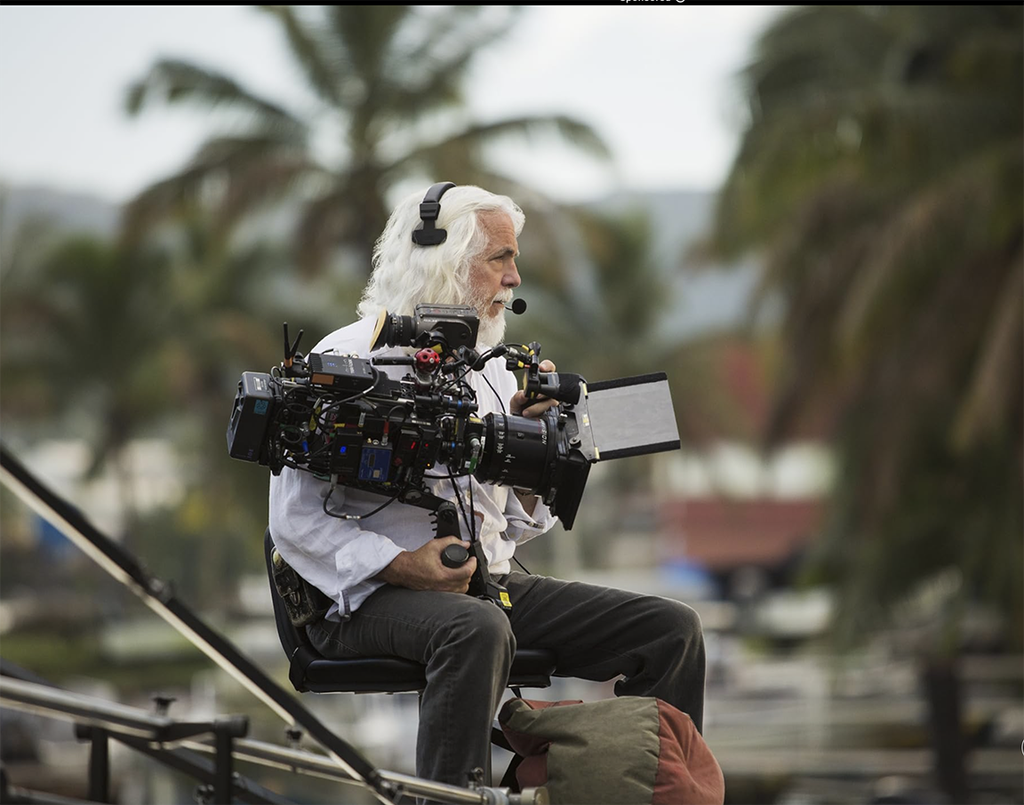
If you pull up the ingeniously inventive trailer for Quentin Tarantino’s Once Upon A Time in Hollywood, there’s a tiny piece of one camera move in the movie that stops the show. It involves two houses in the Hollywood Hills, one owned by fading movie star Rick Dalton (Leonardo Di Caprio), the other, not next door but on higher, more prestigious terrain, occupied by Sharon Tate (Margot Robbie) and her film director husband, Roman Polanski. The camera move starts on Rick floating in his pool, studying lines, and swings up, up, up and completely over the Tate house roof, lowering and coming to rest on the actress and Polanski, driving off to a party. The shot has no cuts or CGI computer assists, and was captured by a giant remote controlled Techno-crane plotted out by Robert Richardson, the picture’s cinematographer. Which is one reason Tarantino avows, “there’s Bob Richardson, and then there’s everyone else.”
This uniquely fashioned biography of three-time Oscar winner (Platoon, JFK, Hugo) Richardson is on a par with two other top-of-the mark feature docs on directors of photography, Visions of Light (a 1992 exploration mainly of film noir artisans), and Water and Sugar (2016), an examination of the work of Carlo Di Palma, who somehow managed to win the loyalty of both Michelangelo Antonioni and Woody Allen. What gives the Richardson tale a curious and eventually compelling edge is that its Czech director, co-producer/writer and cinematographer is a 37-year-old graduate of The University of Prague’s FAMU film school. Hojdova set out more a decade ago to research Richardson as the subject of her master’s thesis. Her fan letter in 2016 to the American Society of Cinematographers seeking their help in contacting Richardson, caught his eye. The ASC member promptly mailed her 2,000 images.
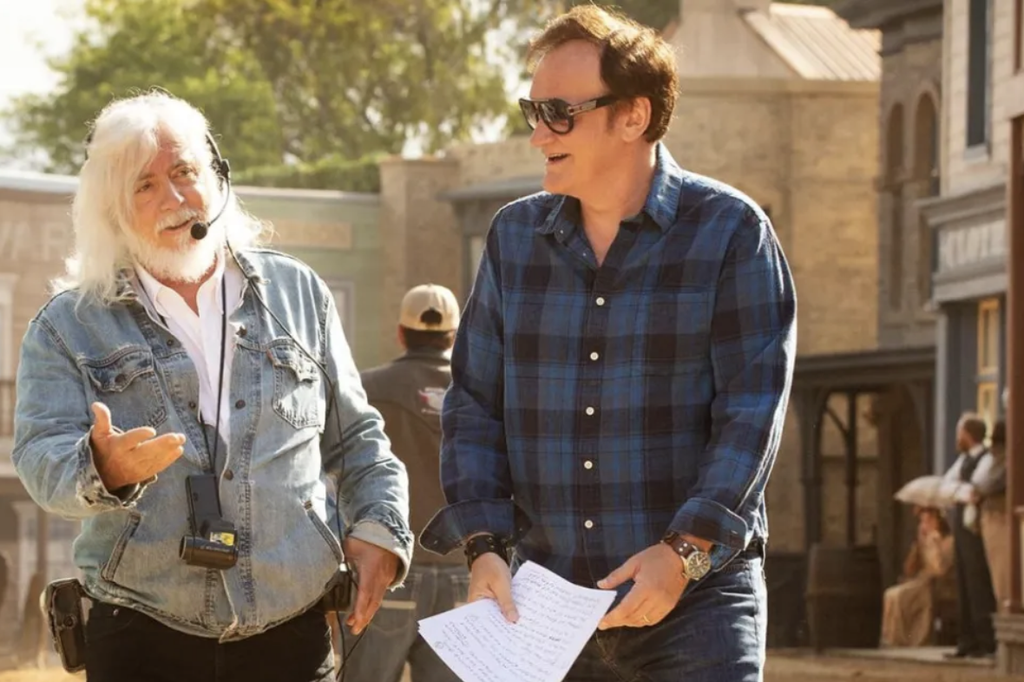
Hojdova’s timing was perfect as COVID had shut down film production and Richardson had sequestered himself in a Cape Cod beach home. He invited his new protege in for a visit that turned into three months. She’d done her homework and had 1,001 questions he was willing to answer—not just about his work with Oliver Stone (11 features), Martin Scorsese (6 features) and Tarantino (5 features), but about his ruinous childhood with abusive and alcoholic parents plus a younger addicted brother. All three directors he worked for weigh in with the kind of kudos you’d expect about a superior combat photographer whose first and lasting film influence was Ingmar Bergman. They’re in agreement he’d earned his White Devil sobriquet for both his cascading snow white hair as well as a tireless work ethic that could turn tyrannical.
Richardson becomes the narrator of his unhappy childhood in a family of drinkers that carried into his adulthood. And Hojdova shapes her subject as a man most happy when he was piloting a crane, “a seat you can’t share with anyone else.” Hojdova and her peerless editors, Giordano Bonora Groome and Elisa Bonora, have deftly woven the pieces of a lifetime making movies into an Academy-level doc. As a Hollywood lensman Richardson may be unequaled, but as a husband and father (three marriages, four children), most of the time he simply wasn’t there. Viewing one Oscar acceptance speech he’d made, he glumly realizes he thanked everyone except his wife. This appears to be the dual legacy both DP Robert and DP Jana want the world to judge, and for once in a filmic biography it’s not just the legend that gets printed, but all its painful truths.
Black Soil: Nicholas Weissman, Caitlin Ochs: 2026: United States: 23 minutes
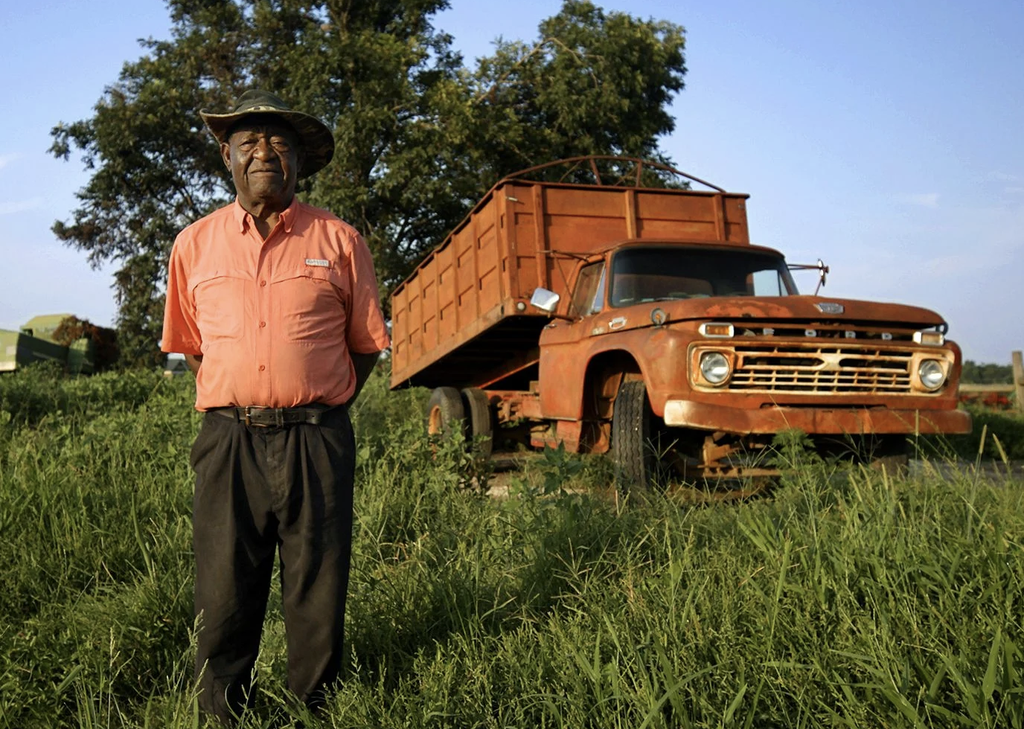
While the Harlem Renaissance was culturally uplifting a New York community in the 1920s and 30s, a Black Mississippi farmer, Nathan Allen, was spending a half century of his life raising corn. Thanks to President Roosevelt’s New Deal program, the Allens and 42 other Black families in the Mississippi Delta were given the right in 1940 to purchase 40 acres of prime farming land in the Mississippi Delta near Yazoo City. (“40 Acres And a Mule” is the name of professor/director Spike Lee’s production company.)
When Allen passed in 2006, Herbert Allen Jr. and his son Trentis, with brothers Freddie and Clarence and their families, kept on raising corn and other crops, plus cows. They’ve combined modern day tools with the knowledge gained from their ancestors. The Allens approached a professor at the University of North Carolina, Emanuel Harris II, thinking their history might be a story worth passing on. Harris’ forthcoming book on the Allen family was spotted by Weissman, an Emmy award winning documentarian, and Ochs, a National Geographic Explorer. The result is Black Soil, a startling discovery among 88 other shorts in this DOC NYC. It’s been shown in Hot Springs, Memphis, and now New York City.
The 23 minutes are simple exposition. We examine seedlings and worms, note the superior length and color of ears of corn raised in prime Delta clay, attend a church service, view the gravesites of parishioners and family members. The overhead shots of the Allen property have a gentle, soothing gravity. Other family members at an Allen reunion each get a portrait shot. Everyone is working away on 1,500 acres, grown from the original 40. The history and legacy of one farm family continues unbroken.
When Once Upon a Time in Harlem is nominated for the Oscar for Best Documentary Feature, win or lose, David Greaves’ doc will expand its distribution, and Greaves might look into adding Black Soil, the ideal companion to open his movie. That way both the 105 minute Harlem celebration and the 23 minute Mississippi celebration will together find the wider audiences each richly deserves. Let’s not forget every feature presentation in theaters for decades was preceded by a short, usually a cartoon. Today it’s three cartoons worth of trailers. Why not follow those previews with a superior Black short? This is For Your Consideration.
This concludes critic’s choices. After 35 consecutive years, The New York Jewish Film Festival has announced it’s pausing its 2027 edition and will return in 2028. Watch for Brokaw’s picks in Rendez-Vous with French Cinema, March 4-14, 2027.
###
Regions: New York City